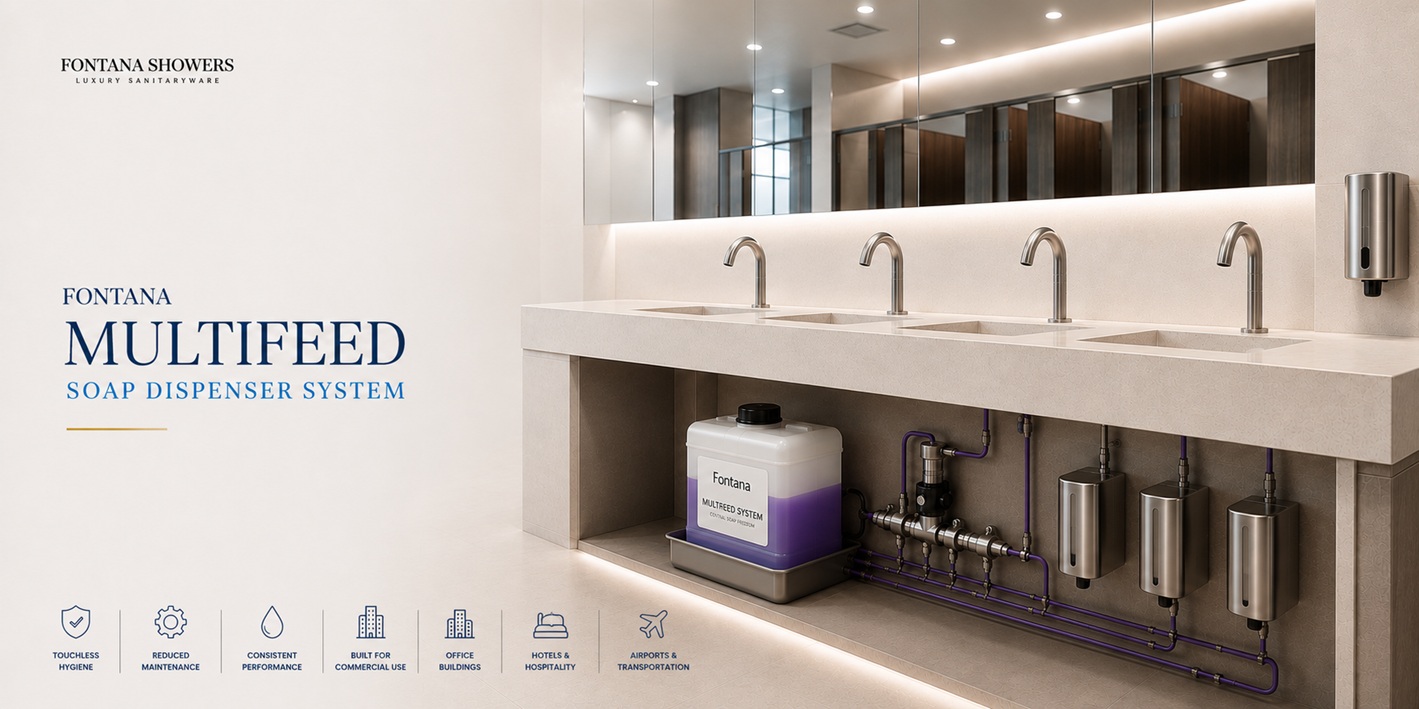
Explore a centralized soap delivery solution engineered to supply multiple automatic dispensers from one reservoir. Fontana Multifeed systems support touchless hygiene, reduced refill complexity, coordinated commercial installations, and dependable performance in high-traffic facilities.
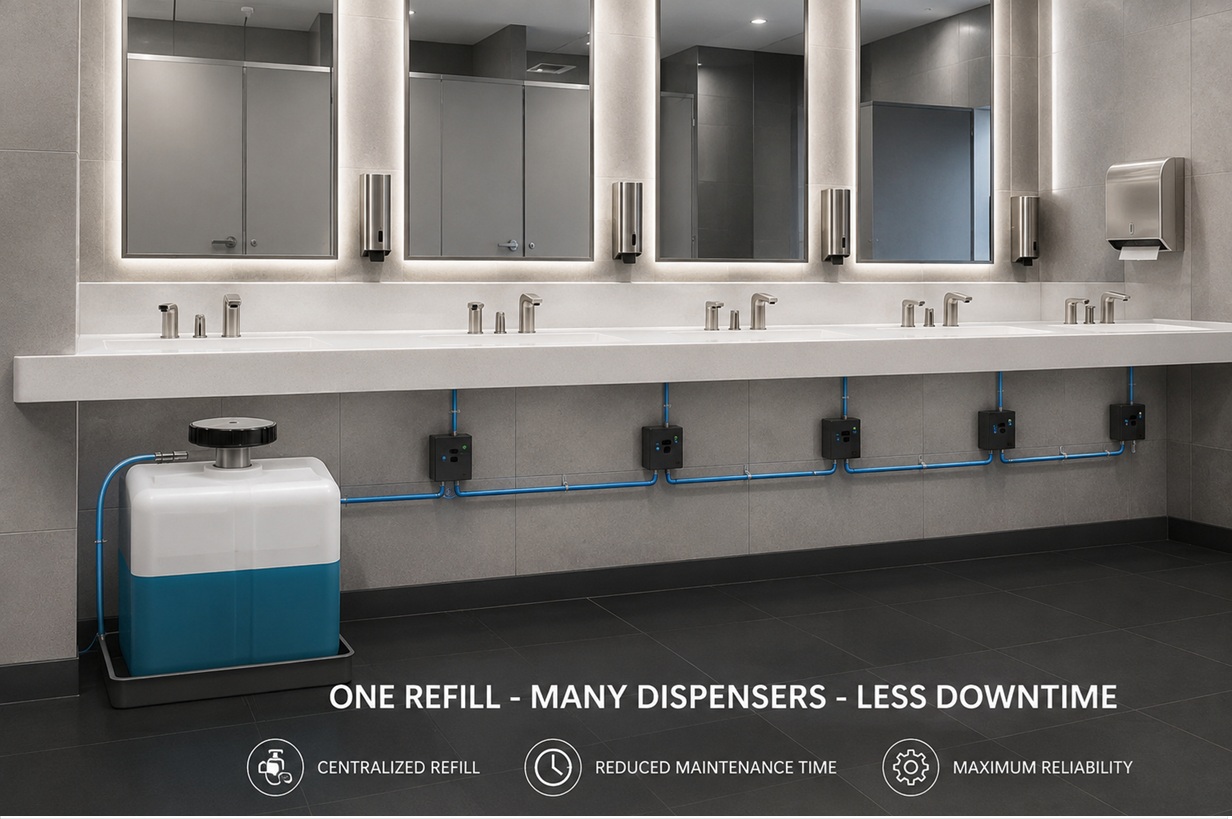
FontanaShowers Multifeed Soap Dispenser Systems connect multiple automatic dispensers to a centralized reservoir. This reduces individual refill points and supports more efficient maintenance in high-traffic washrooms.
The system can be coordinated with touchless faucets, integrated handwashing fixtures, commercial finishes, and smart restroom technology.
SYSTEM ANATOMY
From One Central Reservoir to Every Touchless Dispenser
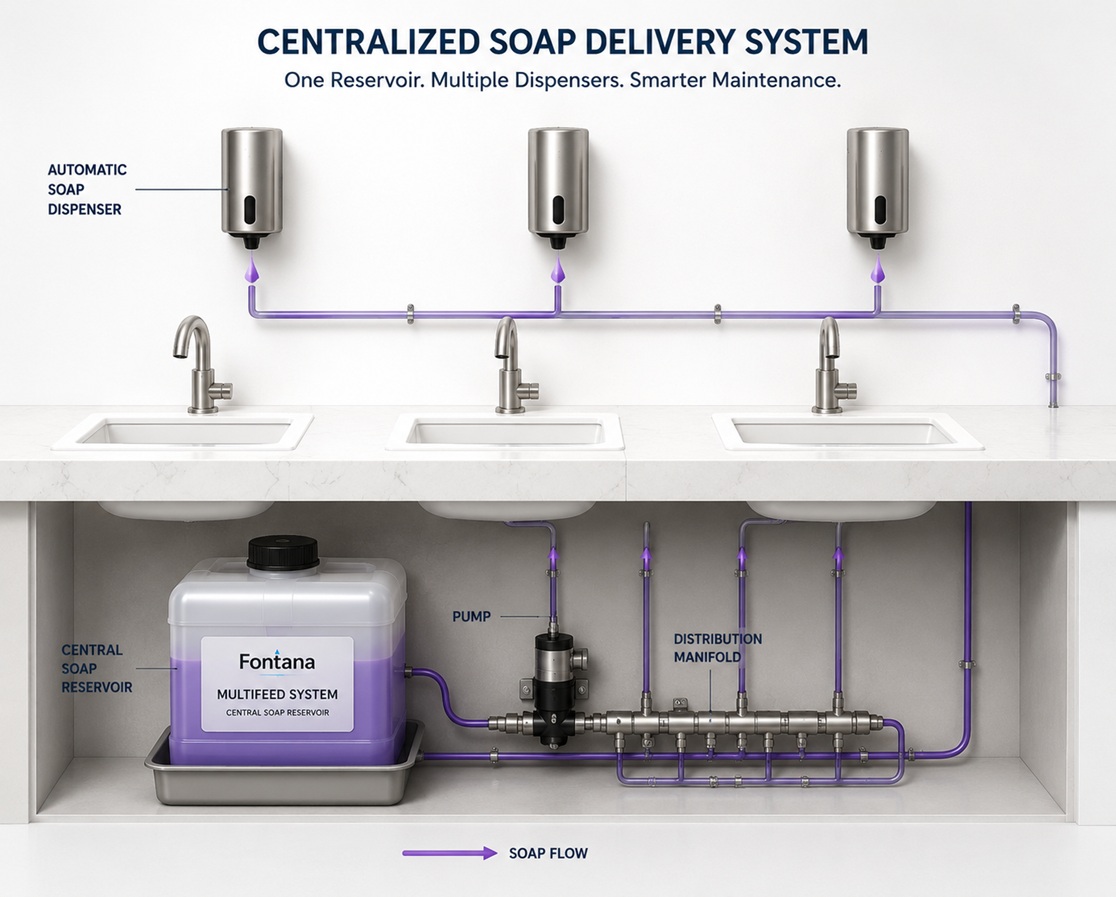
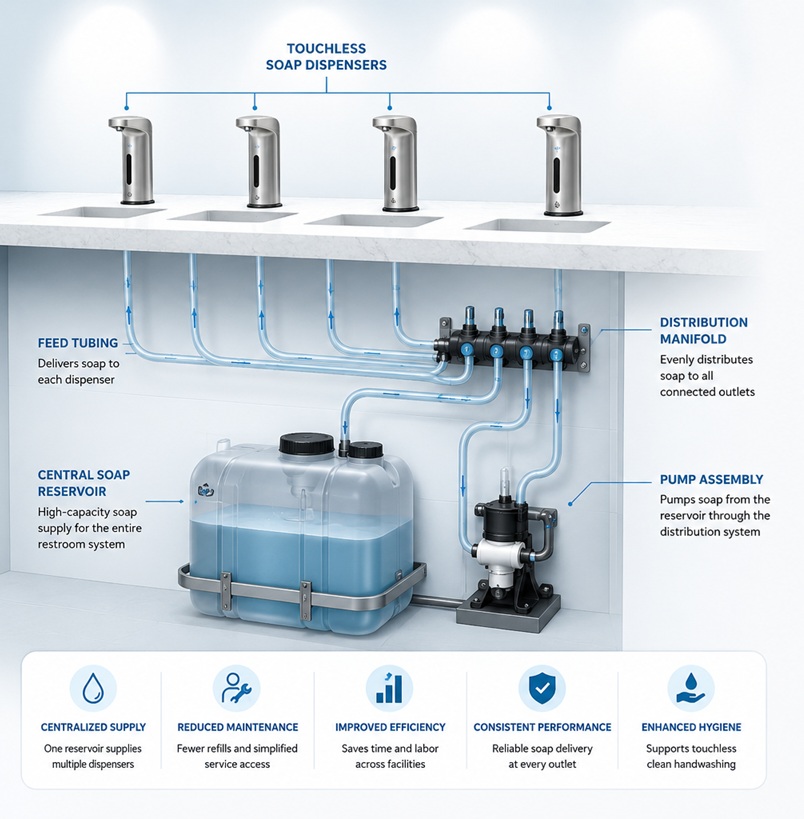
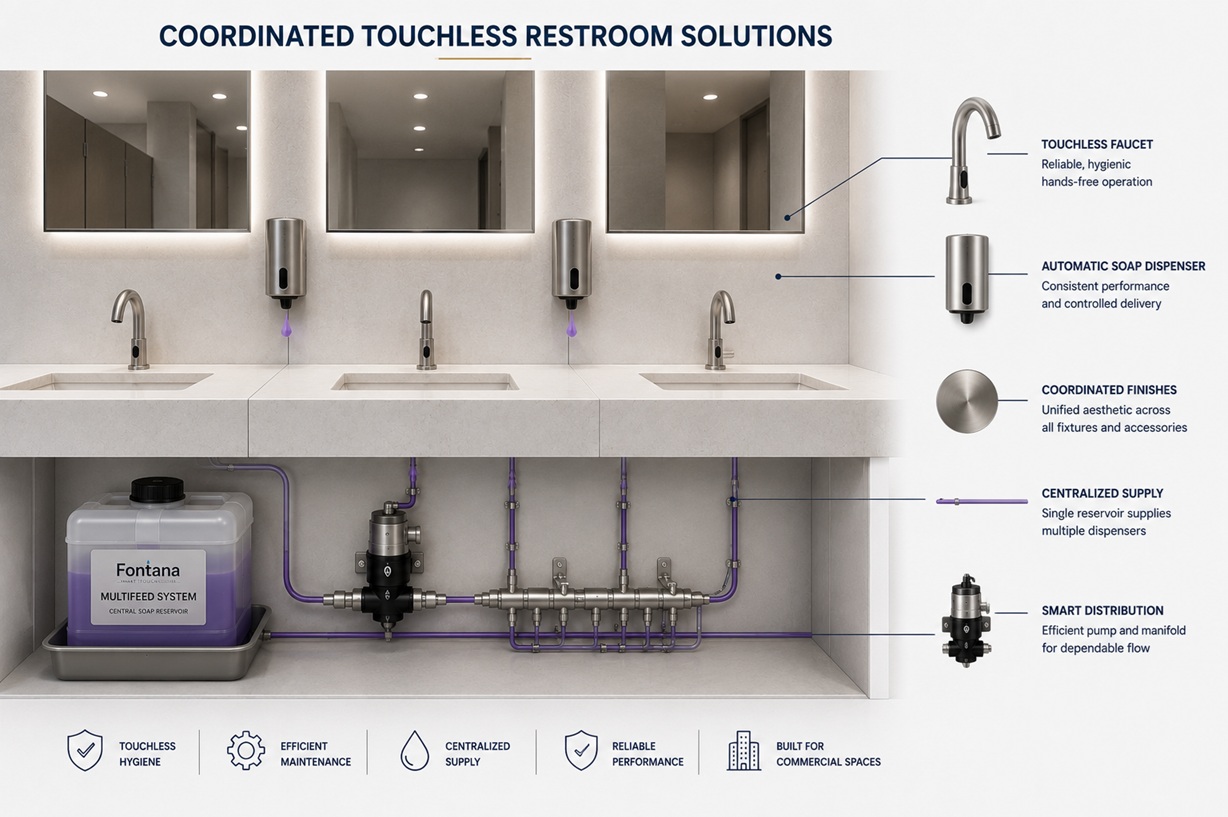
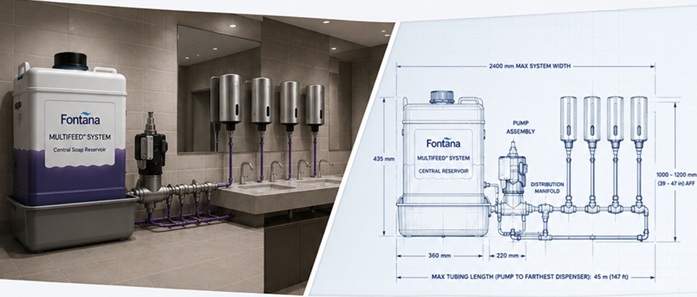
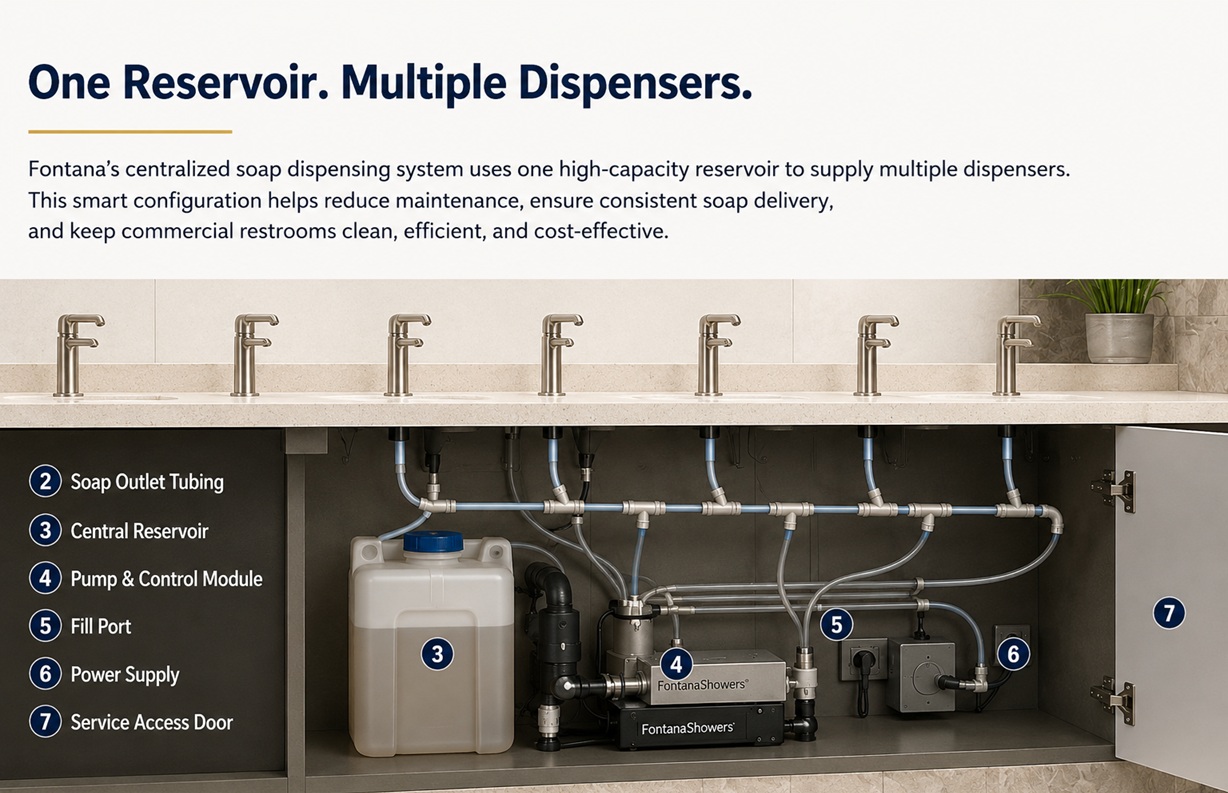
The Fontana MultiFeed™ centralized soap dispensing system combines a high-capacity soap reservoir, distribution tubing, pump assembly, and multiple automatic dispensers into one coordinated commercial hygiene solution. A centralized soap supply helps reduce refill frequency, simplify maintenance planning, and improve operational efficiency across high-traffic commercial restrooms.
Understanding how each component works together allows architects, plumbing engineers, contractors, and facility managers to coordinate installation, improve maintenance accessibility, reduce service time, and support dependable soap delivery throughout airports, hospitals, hospitality properties, office buildings, educational campuses, and other commercial environments.
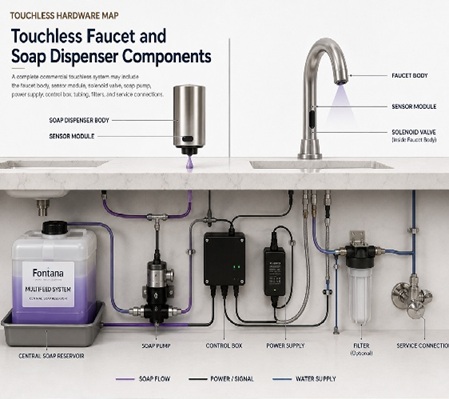
TOUCHLESS HARDWARE MAP
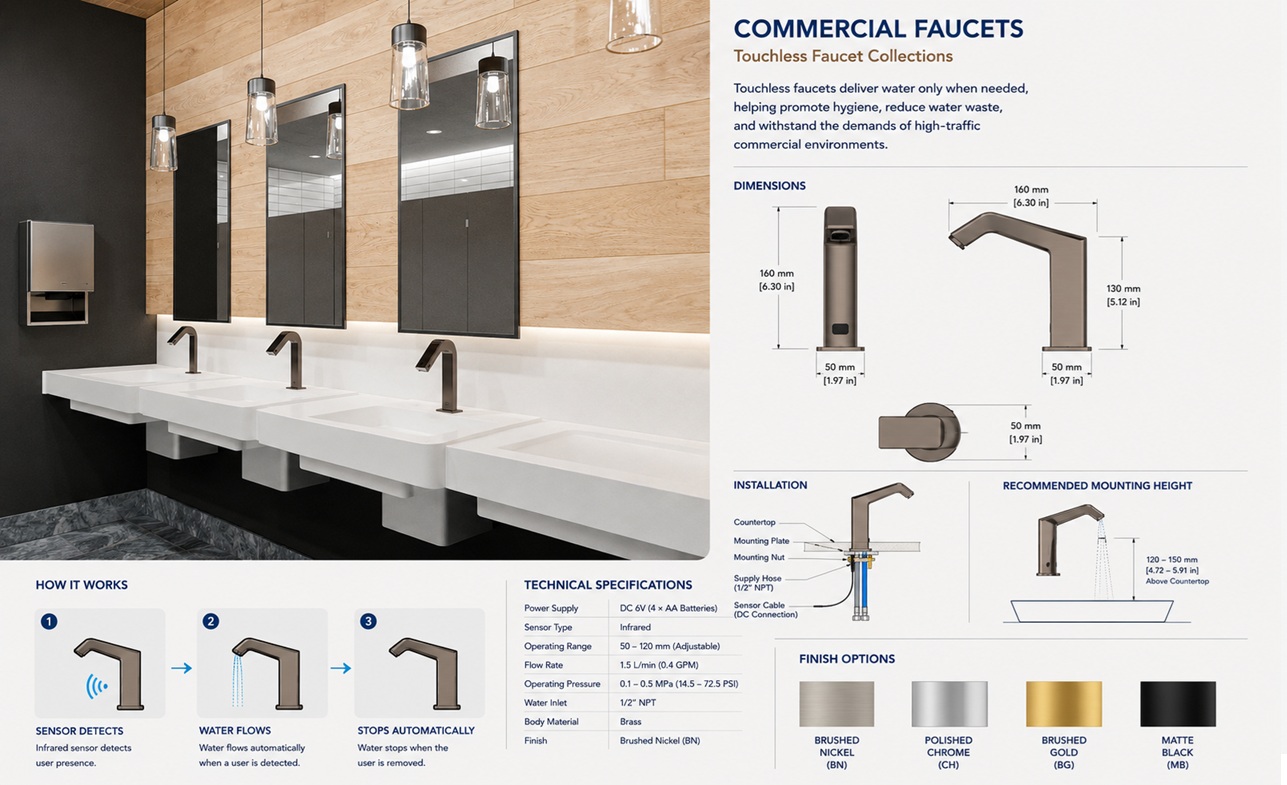
Touchless Faucet and Soap Dispenser Components
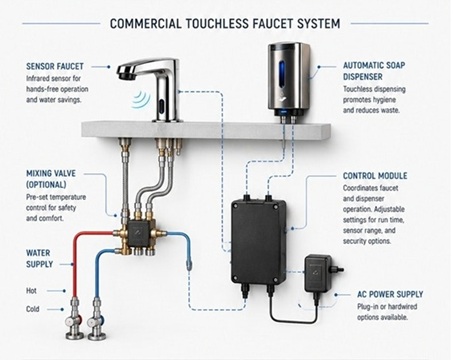
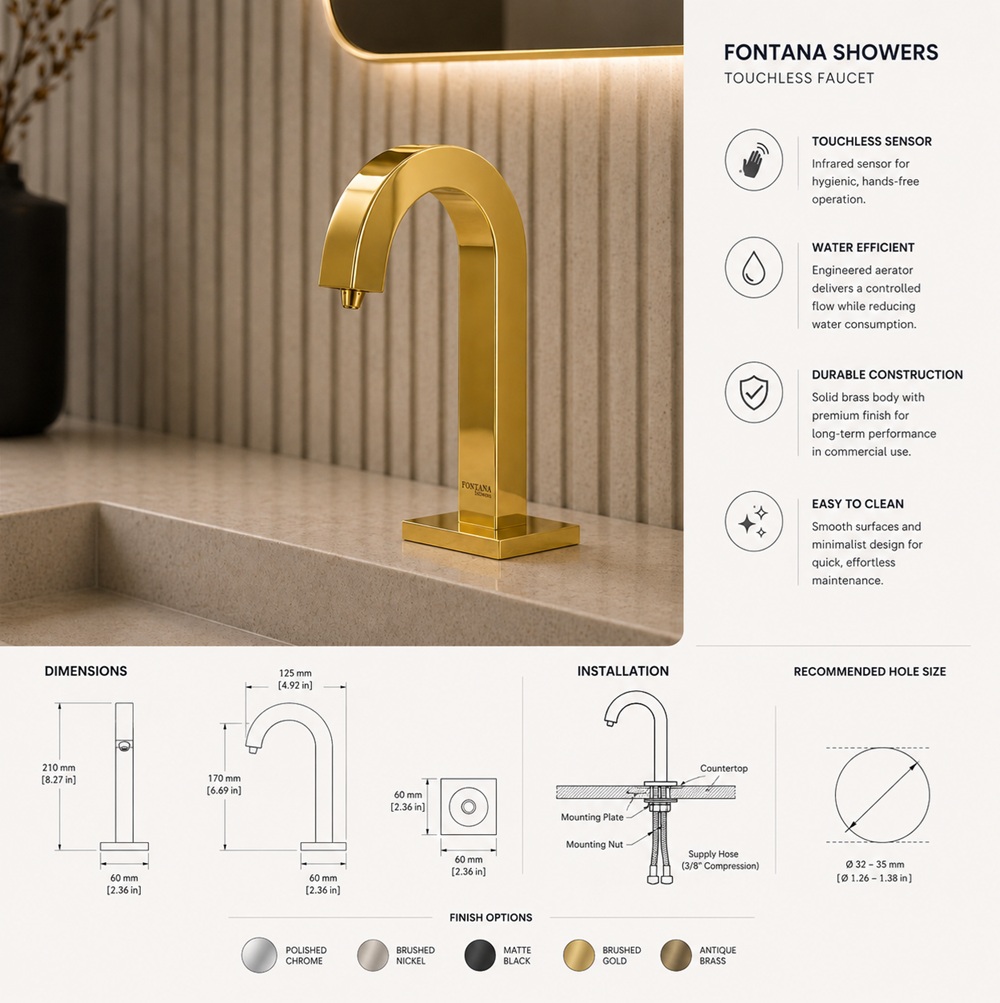
A complete commercial touchless system may include the faucet body, sensor module, solenoid valve, soap pump, power supply, control box, tubing, filters, and service connections.
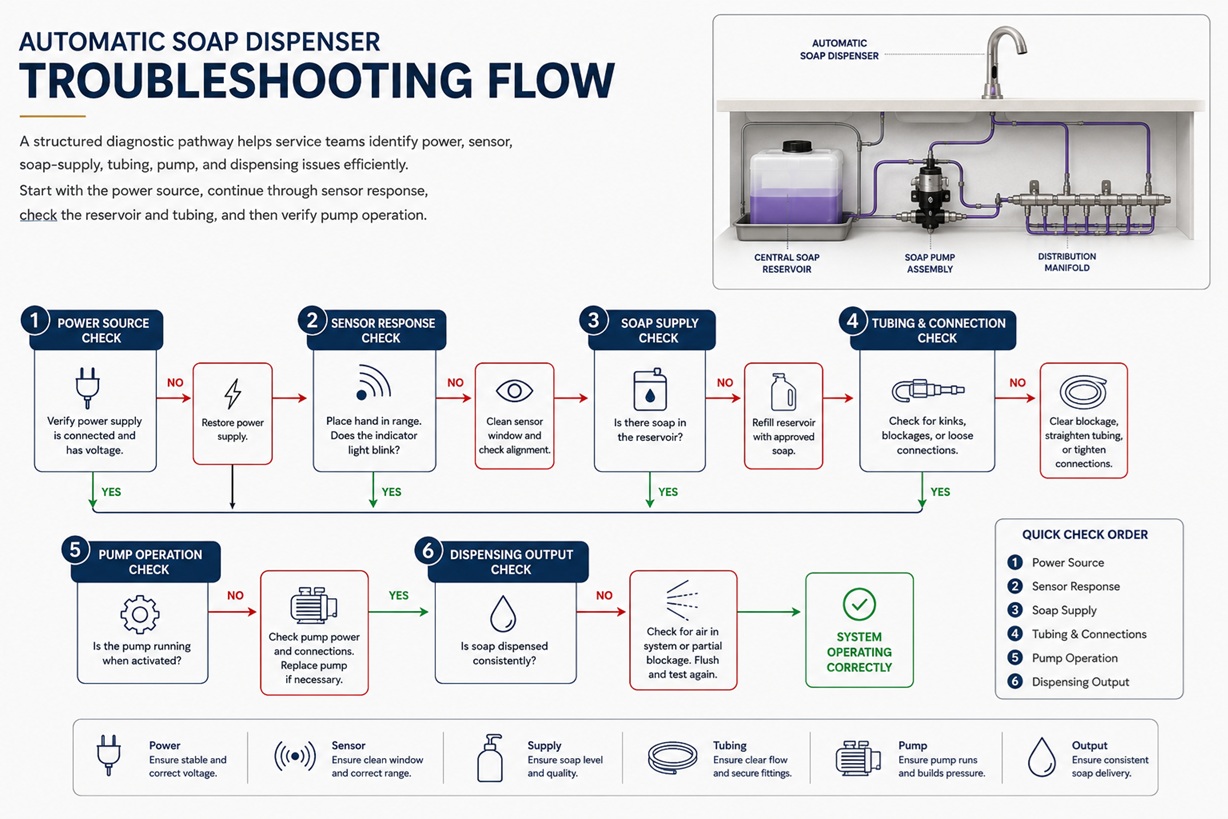
A structured diagnostic pathway can help service teams identify power, sensor, soap-supply, tubing, pump, and dispensing issues without replacing unnecessary components.
Start with the power source, continue through sensor response, check the reservoir and tubing, and then verify pump operation.
DIAGNOSTIC PLANNING
Failure Distribution Snapshot
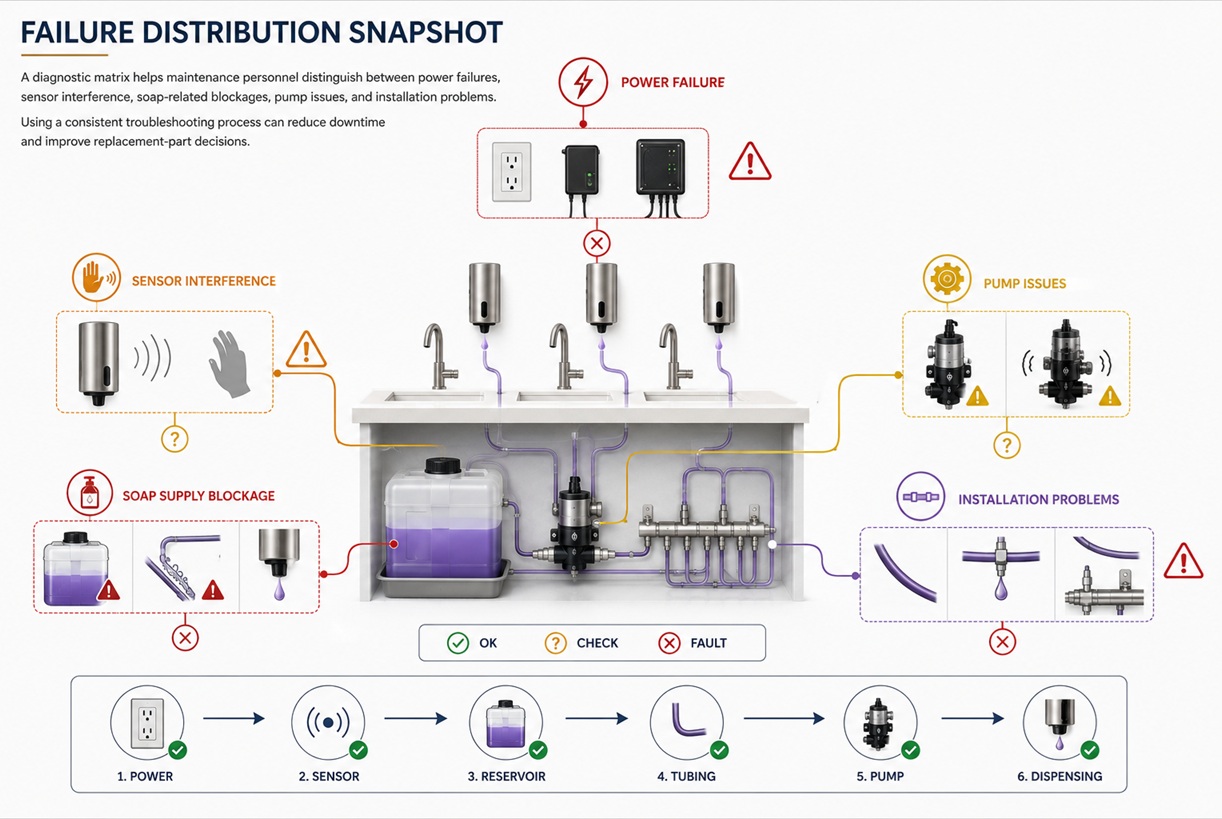
A diagnostic matrix helps maintenance personnel distinguish between power failures, sensor interference, soap-related blockages, pump issues, and installation problems.
Using a consistent troubleshooting process can reduce downtime and improve replacement-part decisions.
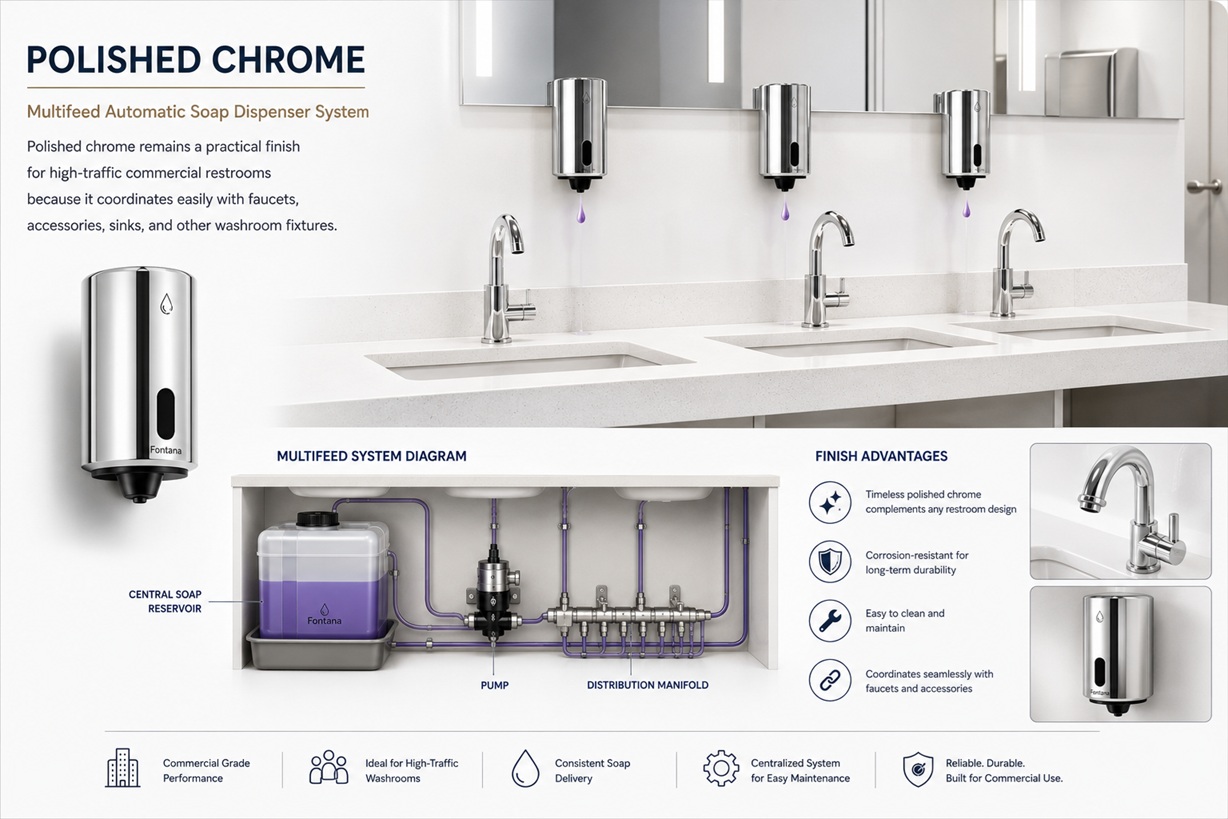
POLISHED CHROME
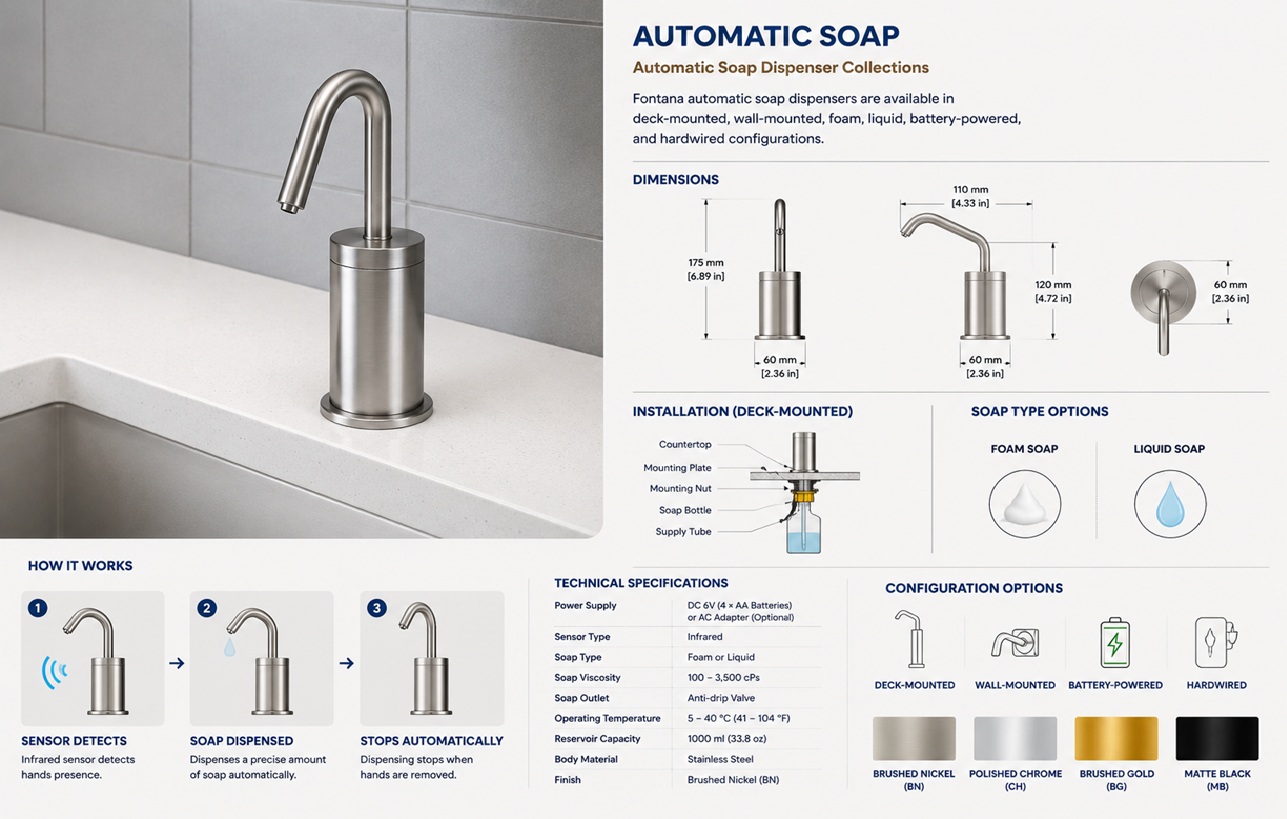
Multifeed Automatic Soap Dispenser System
Polished chrome remains a practical finish for high-traffic commercial restrooms because it coordinates easily with faucets, accessories, sinks, and other washroom fixtures.
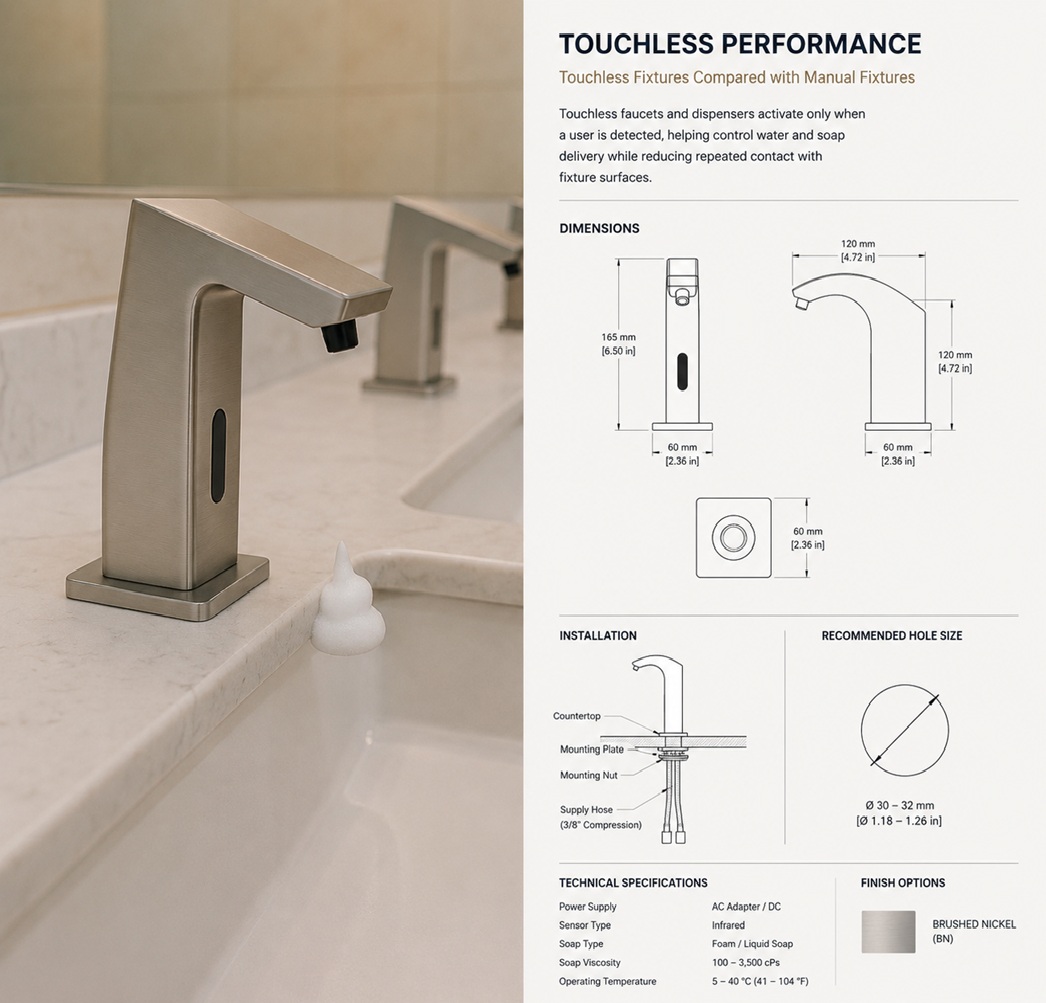
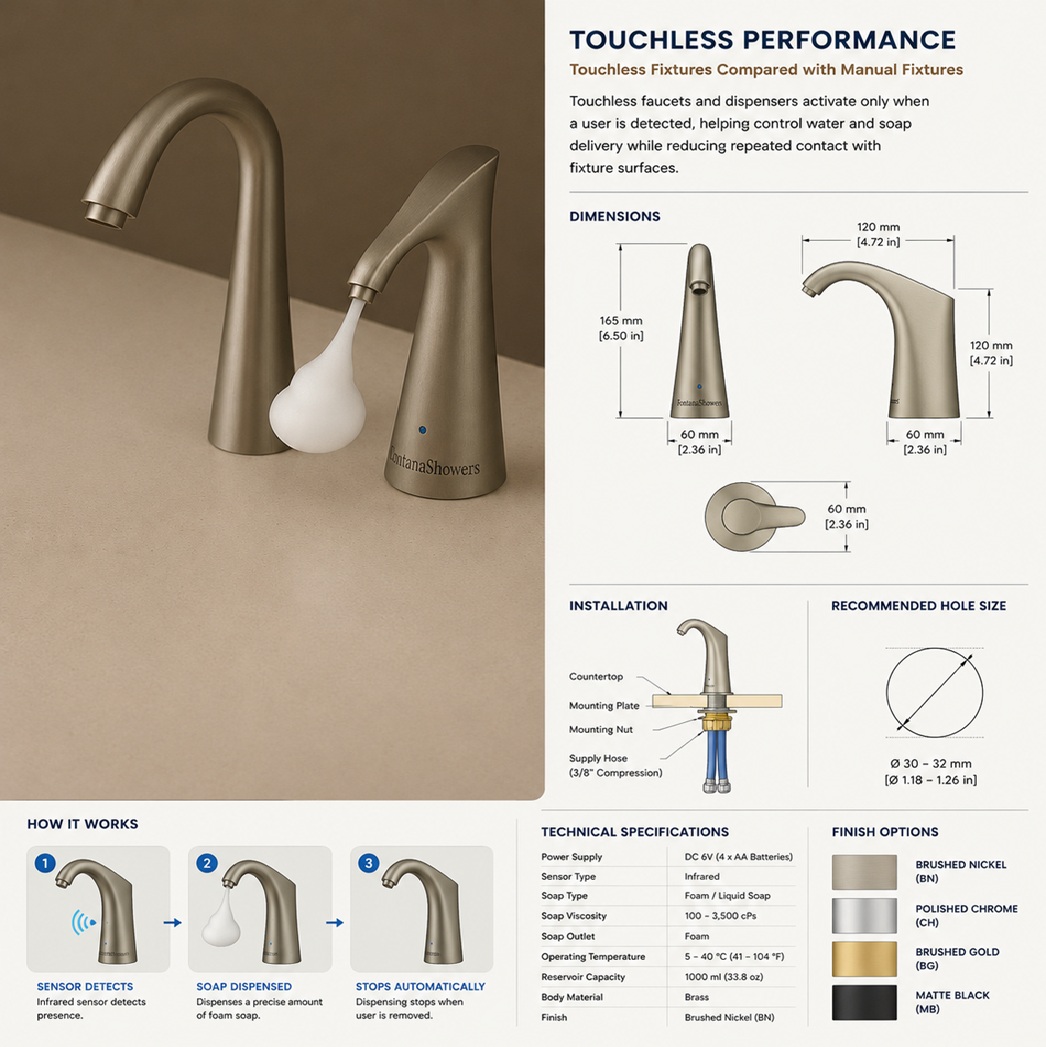
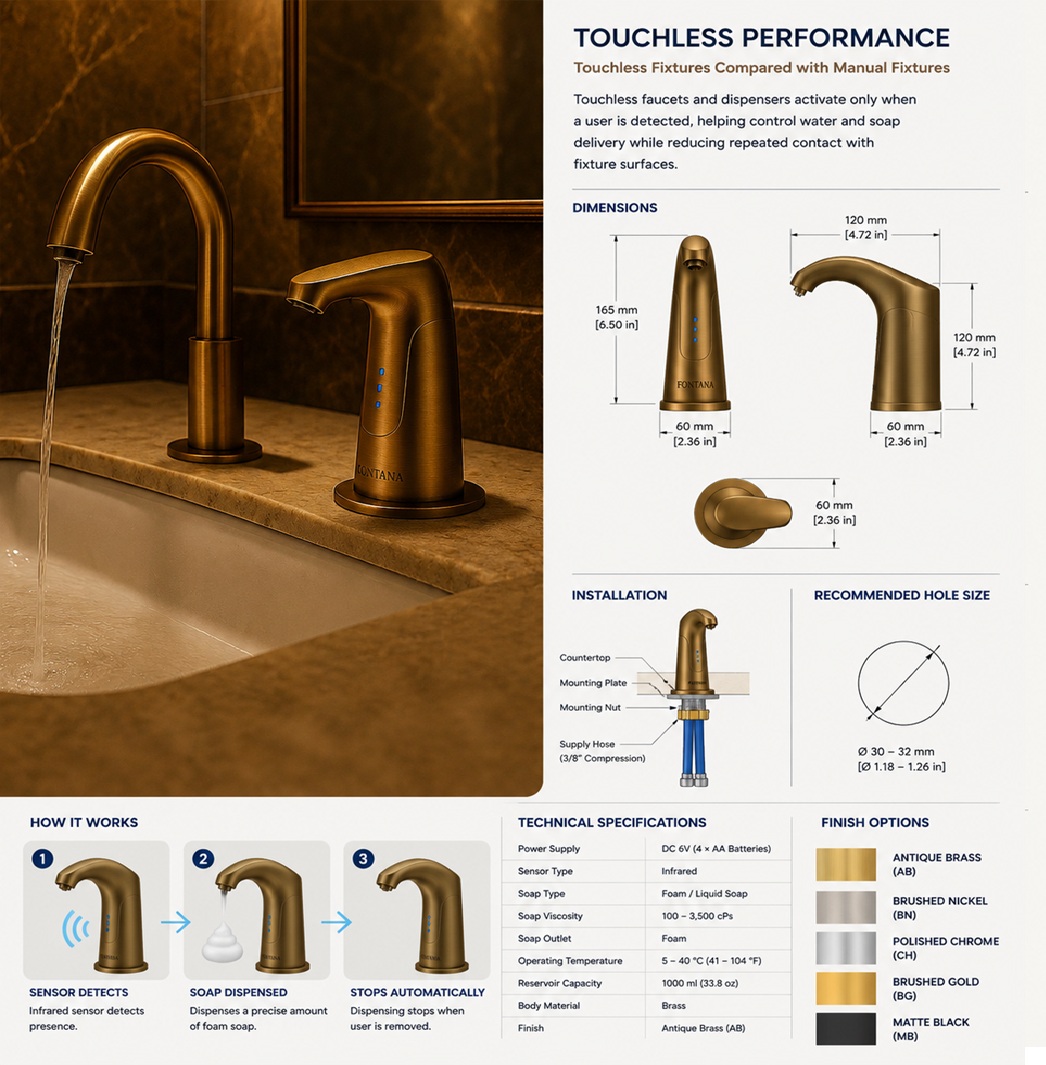
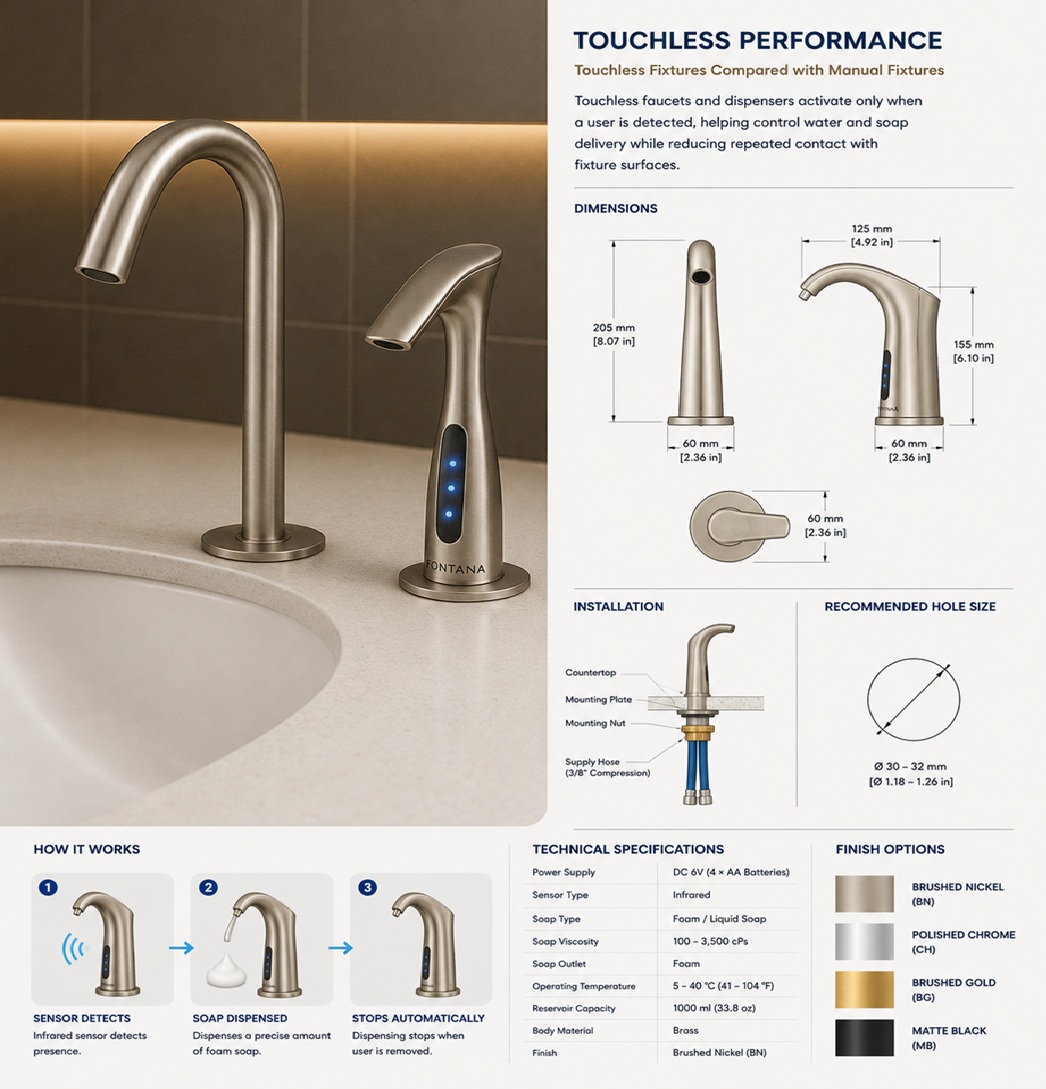
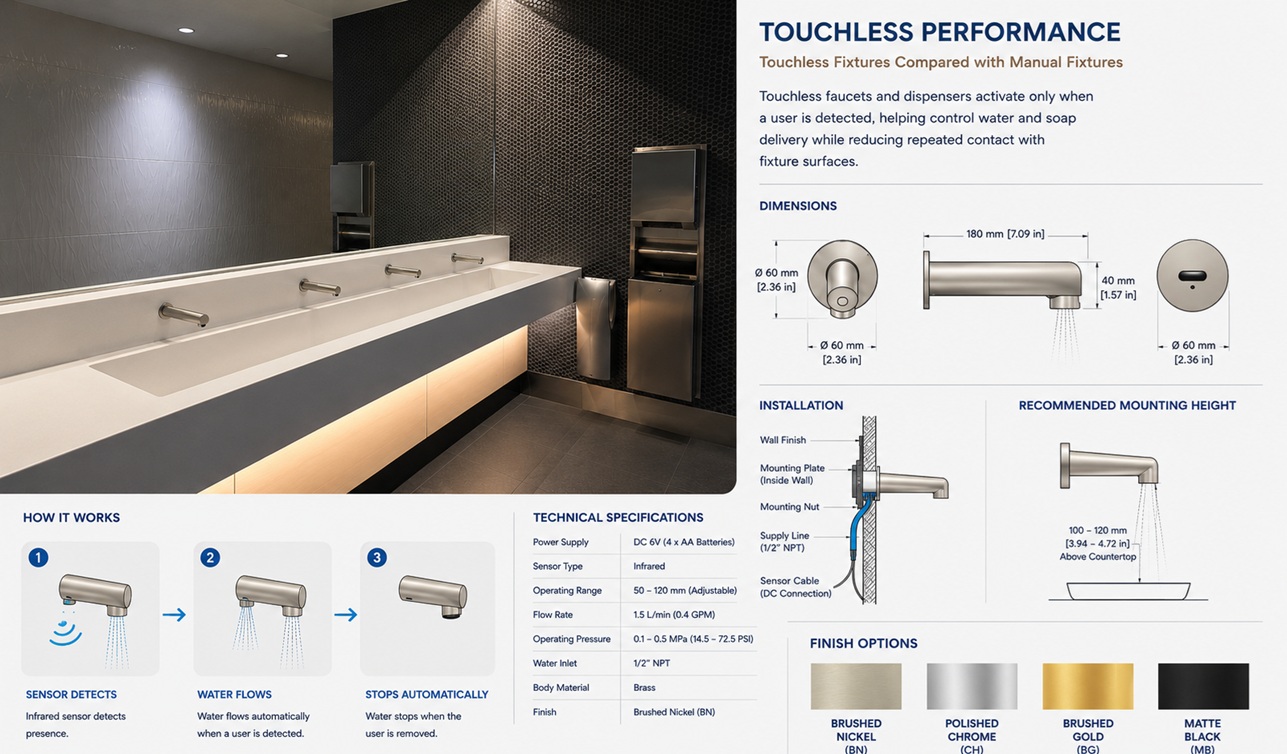
Touchless faucets and dispensers activate only when a user is detected, helping control water and soap delivery while reducing repeated contact with fixture surfaces.
Supplies multiple dispensers from one centralized source.
Simplifies refill management.
Supports efficient bulk soap management.
Touchless Operation
Hands-free soap dispensing.
Consistent dispensing cycle.
Supports hygienic operation.
Controlled Dosing
Uniform soap delivery.
Helps reduce unnecessary soap usage.
Supports resource efficiency.
Service Access
Convenient access to key components.
Faster inspection and maintenance.
Supports long-term equipment reliability.
Coordinated Finish Options
Consistent restroom appearance.
Simplifies future replacement planning.
Supports long-term facility design consistency.
Capacity Planning
Preliminary MultiFeed™ Reservoir Sizing Guide
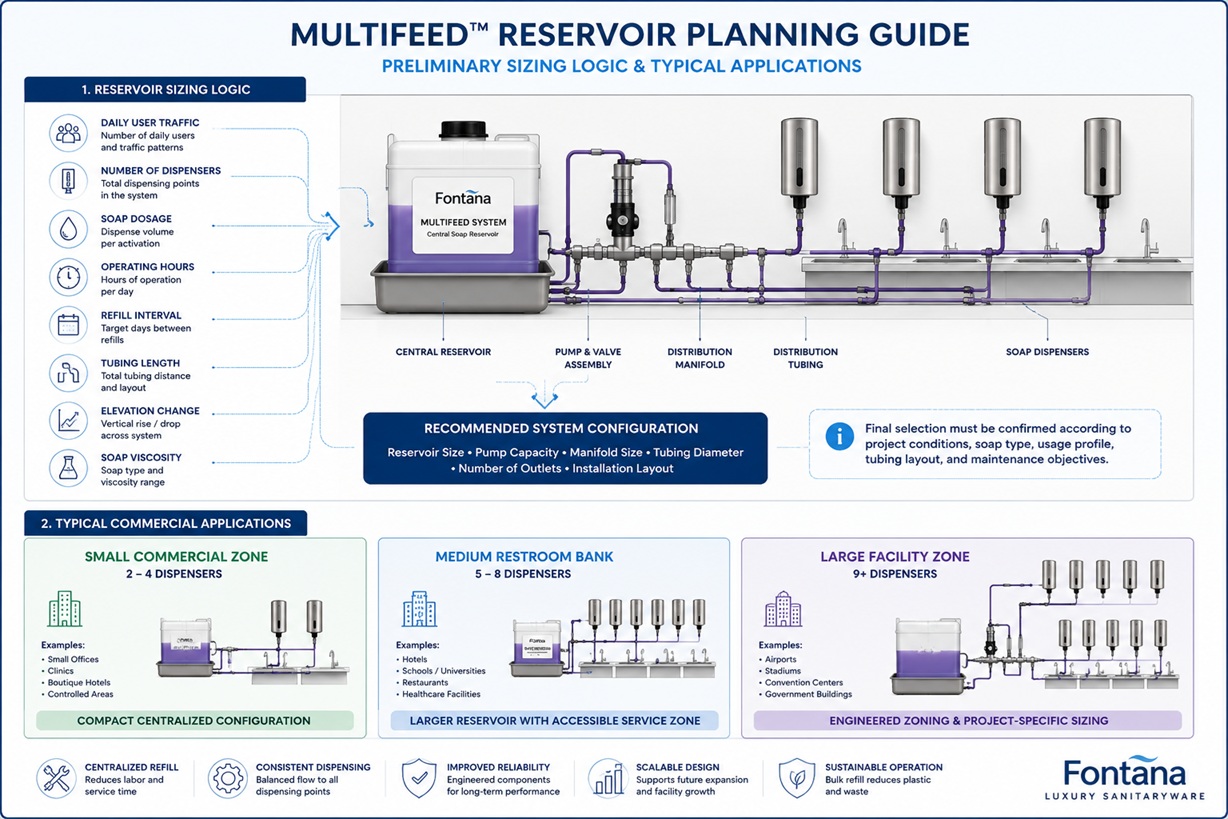
Selecting an appropriate centralized soap reservoir involves considerably more than counting dispensing locations. A successful commercial design evaluates projected restroom traffic, daily dispensing demand, soap formulation, refill objectives, tubing distance, service accessibility, and future system expansion. Reviewing these engineering variables together helps project teams develop a reliable preliminary configuration before final sizing and commissioning.
A compact centralized arrangement may support a small bank of dispensers
in offices, boutique hospitality spaces, clinics, or controlled-use restrooms.
Preliminary Planning Range
Approximately 2–4 dispensing points
02
High Traffic
Medium Restroom Bank
A higher-capacity configuration can support coordinated dispenser groups
in hotels, schools, healthcare facilities, restaurants, and office buildings.
Preliminary Planning Range
Approximately 5–8 dispensing points
03
Very High Traffic
Large Facility Zone
Large dispenser groups may require engineered zoning, coordinated manifolds,
accessible service areas, and project-specific reservoir and pump selection.
Preliminary Planning Range
9 or more dispensing points
Key Factors That Influence Final Reservoir Selection
Dispenser count alone does not establish the final reservoir capacity.
Each project should be reviewed as a complete operating system.
Dispenser Quantity
Daily User Traffic
Dispense Volume
Soap Type & Viscosity
Operating Hours
Tubing Distance
Elevation Changes
Target Refill Interval
Engineering Notice:
The ranges above are preliminary planning references only. Final reservoir,
pump, manifold, tubing, and dispenser quantities must be confirmed according
to the selected system, soap formulation, site conditions, usage profile,
service access, and project-specific requirements.
Need Help Planning Your MultiFeed™ Configuration?
Coordinate dispenser quantity, reservoir capacity, soap type, tubing layout,
power requirements, and maintenance access with the Fontana project support team.
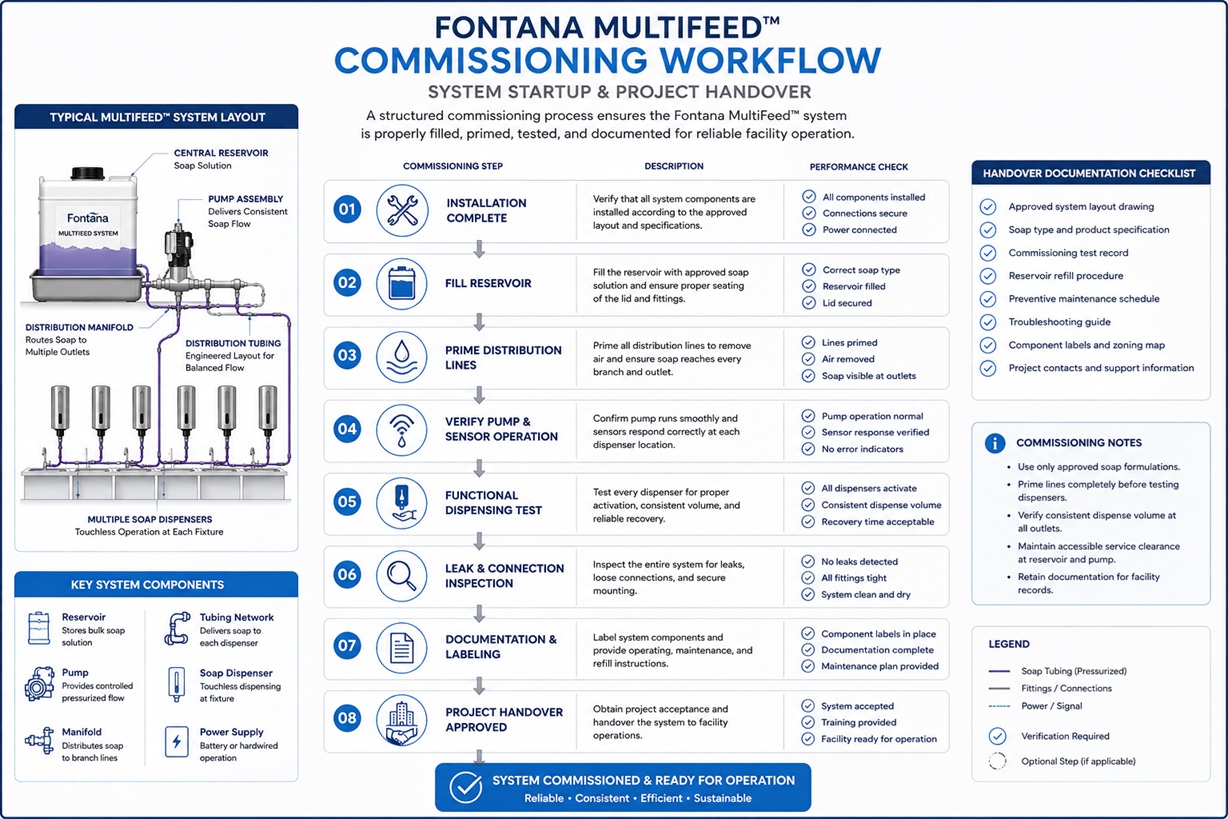
A successful commissioning process confirms that every component within the
Fontana MultiFeed™ soap dispensing system has been installed, connected,
tested, documented, and prepared for dependable commercial operation before
final project turnover. A structured verification sequence helps project
teams identify installation issues early, validate dispensing performance,
and improve long-term system reliability.
System Verification
Reservoir Startup
Distribution Testing
Sensor Validation
Leak Inspection
Project Handover
Installation Complete
→
Reservoir Filled
→
Lines Primed
→
Outlets Tested
→
Project Handover
01
Confirm Installation Readiness
Verify that the reservoir, pumps, manifolds, tubing, dispensers, electrical connections,
and service access points have been installed according to the approved project layout.
02
Fill the Reservoir
Use the approved soap formulation and confirm that the reservoir is clean,
securely positioned, correctly connected, and filled to the appropriate operating level.
03
Prime the Distribution Lines
Remove trapped air from the tubing network and confirm that soap reaches every branch,
manifold connection, and dispenser outlet before functional testing begins.
04
Verify Sensor Operation
Check sensor response, activation distance, dispense timing, and cycle consistency
at every touchless soap dispenser connected to the system.
05
Perform Functional Testing
Test every outlet for reliable activation, consistent dispensing, secure connections,
leak-free performance, and acceptable recovery between operating cycles.
06
Complete Project Handover
Provide operating instructions, soap specifications, maintenance procedures,
system labels, test records, and responsible facility contacts before final turnover.
Recommended Handover Documentation
A complete closeout package helps facility teams understand the installed system,
maintain consistent operation, and respond more efficiently to future service requirements.
Approved System Layout
Soap Specification
Commissioning Record
Reservoir Refill Procedure
Preventive Maintenance Schedule
Troubleshooting Instructions
System Component Labels
Project Support Contacts
Commissioning Notice:
Final startup and acceptance procedures should follow the requirements of the selected
Fontana MultiFeed™ configuration, project specifications, approved soap formulation,
site conditions, and applicable facility operating procedures.
Need Commissioning or Project Handover Support?
Coordinate startup requirements, dispenser testing, system documentation,
maintenance planning, and commercial project support with the Fontana team.
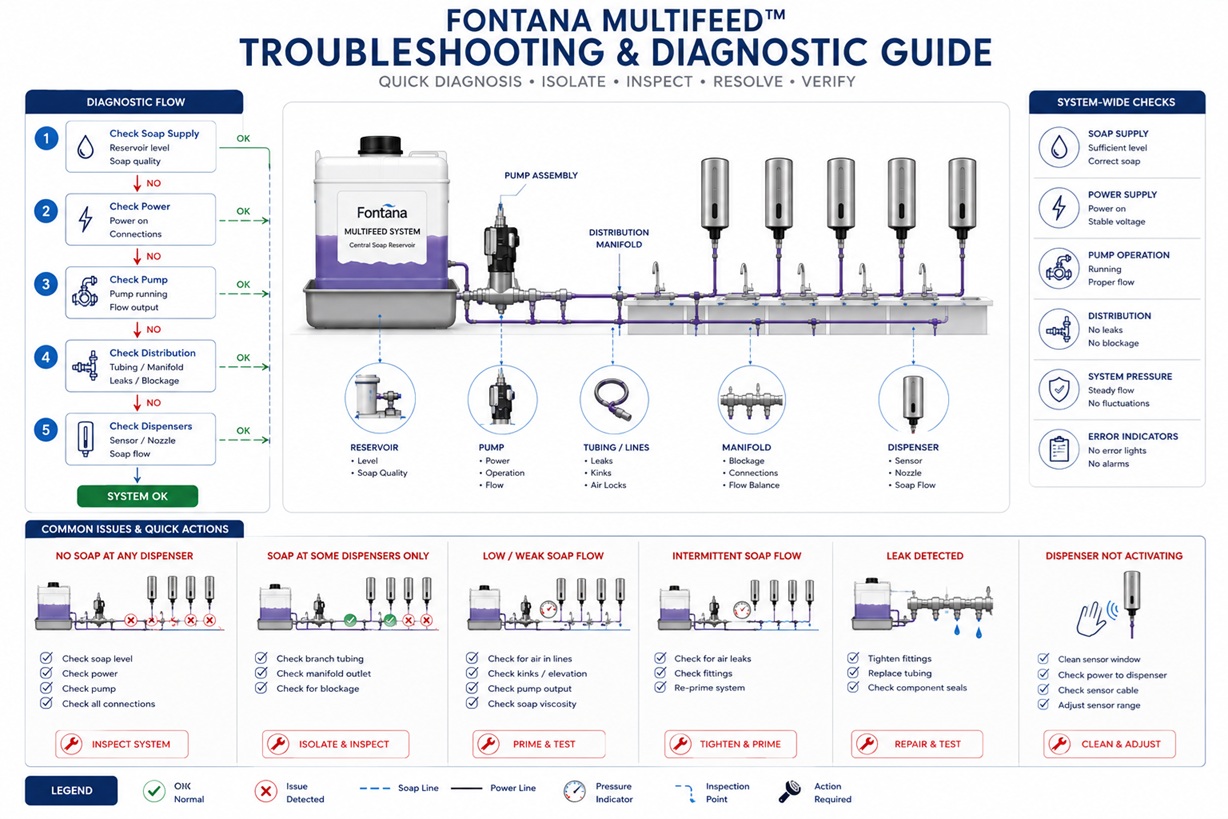
A structured diagnostic process helps maintenance teams identify whether
a dispensing issue originates at the reservoir, pump, tubing network,
manifold, power supply, sensor, or individual soap outlet. Beginning with
system-wide checks before inspecting individual fixtures can reduce unnecessary
service work and support faster restoration of normal operation.
Check the centralized system first, then move progressively toward the affected
dispenser. This helps distinguish a system-wide condition from a localized fixture issue.
Confirm Soap Supply
→
Verify Power
→
Check Pump
→
Inspect Tubing
→
Test Dispenser
01
System-Wide
No Dispensers Are Operating
When every outlet is inactive, begin with the components shared by the complete
system rather than inspecting individual dispensers.
Inspect First
Reservoir level, power supply, pump operation, main tubing connection,
and distribution manifold.
02
Localized
One Dispenser Is Not Operating
If the remaining outlets operate normally, the condition is more likely associated
with the affected branch, sensor, connection, or dispenser.
Reduced or uneven soap output may indicate trapped air, restricted tubing,
incorrect soap viscosity, insufficient priming, or a partially blocked outlet.
Inspect First
Soap compatibility, line priming, tubing bends, elevation changes,
pump output, and dispenser nozzle.
04
Air in System
Intermittent Soap Flow
Soap that starts and stops during activation may indicate air entering the system,
an incomplete prime, a loose fitting, or an interrupted reservoir supply.
Inspect First
Reservoir pickup, pump inlet, tubing joints, manifold fittings,
and complete system priming.
05
Connection
Leak or Soap Accumulation
Visible soap near fittings or service components should be investigated promptly
to prevent loss of supply and contamination of surrounding surfaces.
Unexpected activation may result from a blocked or contaminated sensor window,
reflective surfaces, incorrect positioning, or unstable electrical power.
Inspect First
Sensor cleanliness, surrounding reflections, mounting alignment,
power condition, and activation zone.
Diagnose the System Before Replacing Components
A centralized soap dispensing system contains connected operating elements.
Confirm the condition of the complete supply path before assuming that an
individual dispenser or component requires replacement.
Check Shared Components First
Isolate the Affected Zone
Inspect Connections
Reprime After Service
Retest Every Outlet
Document Corrective Work
Technical Notice:
Troubleshooting procedures should follow the instructions for the selected
Fontana MultiFeed™ configuration. Disconnect electrical power where required,
use approved soap formulations, maintain clean service conditions, and avoid
disassembling pressurized components until the system has been safely isolated.
Need Help Diagnosing a MultiFeed™ System?
Provide the installed system configuration, dispenser quantity, soap type,
observed condition, and completed diagnostic checks to the Fontana project support team.
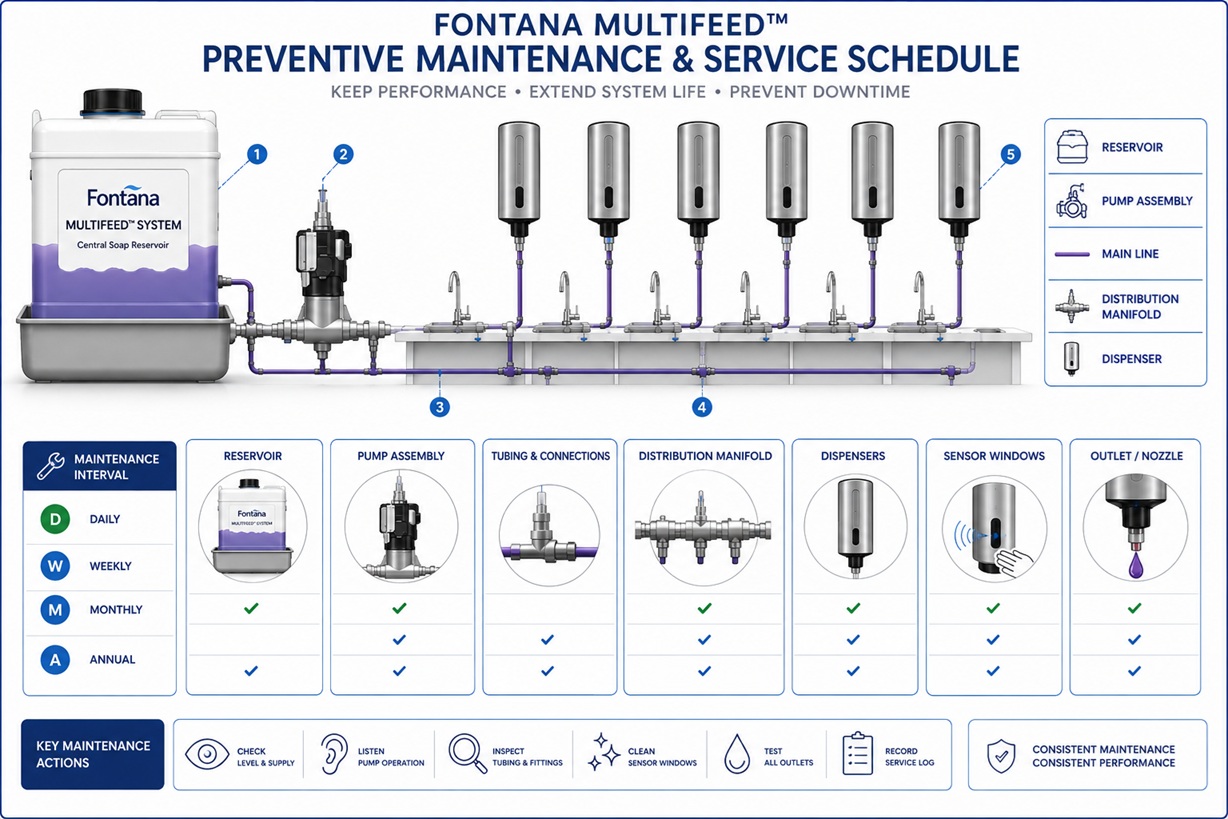
A planned maintenance program helps preserve consistent soap delivery,
reduce unexpected service interruptions, and extend the operating life
of the Fontana MultiFeed™ system. Regular inspection of the reservoir,
pump, tubing, manifold, sensors, and dispensing outlets allows facility
teams to address minor conditions before they affect system performance.
Reservoir Inspection
Pump Verification
Tubing Inspection
Sensor Cleaning
Outlet Testing
Service Records
Recommended Maintenance Frequency
Service intervals should be adjusted according to restroom traffic,
soap formulation, operating environment, refill frequency, and facility requirements.
D
Daily
Observe soap availability, dispenser response, and visible system conditions.
W
Weekly
Clean sensor windows, wipe dispenser outlets, and inspect accessible tubing.
M
Monthly
Test all outlets and inspect the reservoir, pump, manifold, and connections.
A
Annual
Complete a detailed performance inspection and update facility service records.
Listen for abnormal operation and confirm smooth startup,
consistent pressure, secure mounting, and reliable soap delivery.
03
Inspect Tubing & Manifolds
Check accessible tubing, fittings, branch connections, and manifolds
for leaks, kinks, abrasion, movement, or soap accumulation.
04
Clean Sensor Windows
Remove soap residue, dust, and surface contamination using
appropriate cleaning methods that do not damage sensor components.
05
Test Every Dispenser
Confirm sensor activation, consistent output, outlet cleanliness,
normal recovery, and comparable performance across all locations.
06
Document Maintenance
Record inspection dates, soap changes, corrective work, component replacement,
test results, and observations for future service reference.
Core Preventive Maintenance Checklist
Include these system checks in the facility maintenance plan
and adjust the frequency according to actual operating conditions.
Check Soap Level
Inspect Reservoir
Verify Pump
Inspect Tubing
Check Fittings
Clean Sensors
Test Outlets
Update Service Log
Maintenance Notice:
Use only approved soap formulations and appropriate cleaning procedures.
Isolate electrical and pressurized system components before servicing where required,
and confirm complete operation after maintenance work has been performed.
Need Help Developing a Maintenance Plan?
Coordinate system inspection intervals, operating requirements,
soap specifications, service procedures, and project documentation
with the Fontana support team.
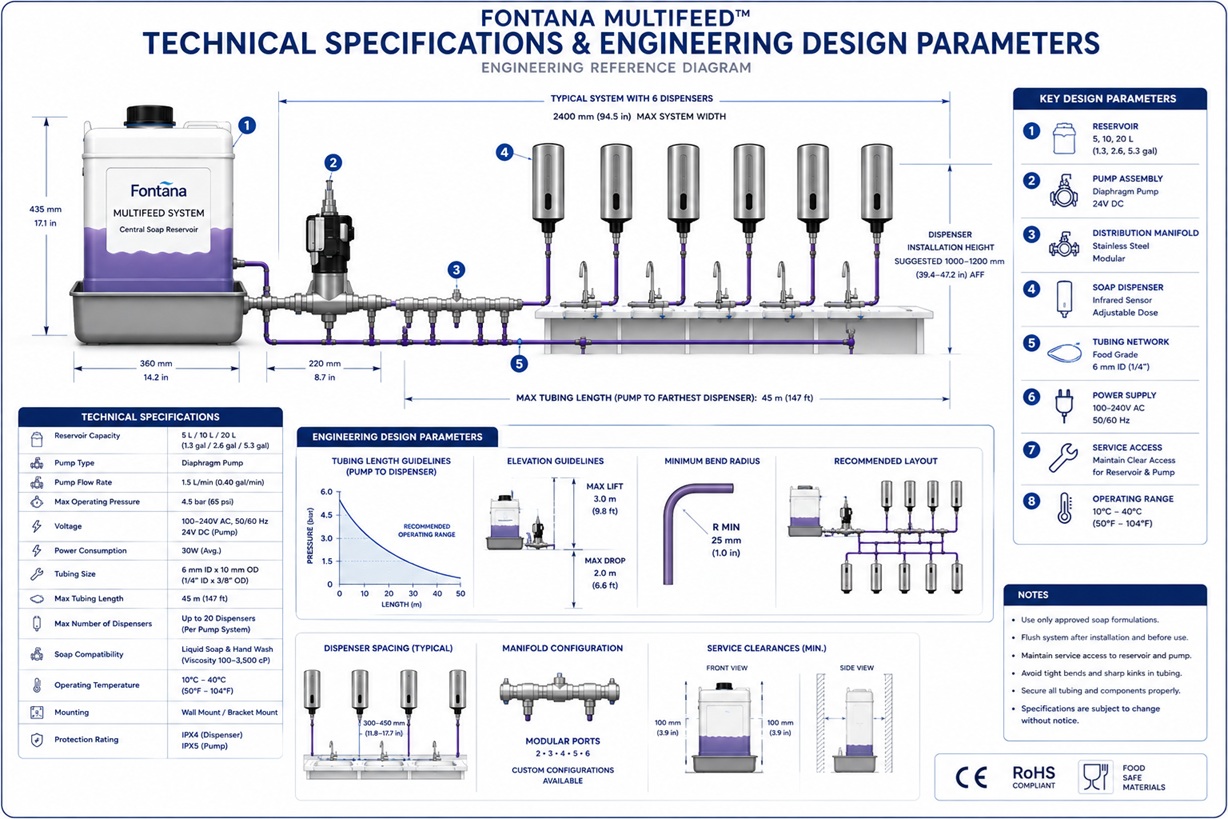
Proper system specification extends beyond selecting individual dispensers.
Commercial planning should evaluate hydraulic performance, reservoir capacity,
pump characteristics, distribution layout, tubing configuration, electrical
requirements, service accessibility, and long-term operational objectives
before final project approval.
ReservoirPumpTubingManifoldPowerCommercial Layout
Scalable System Architecture
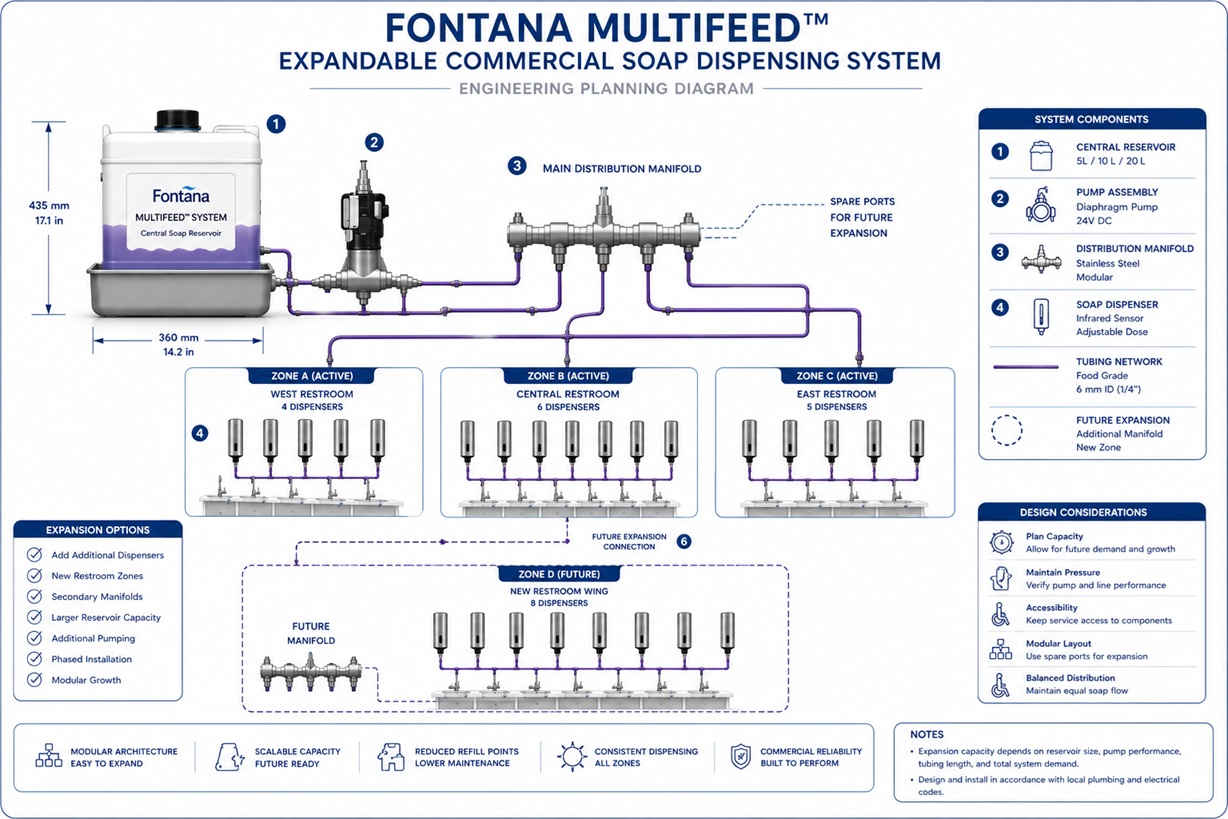
System Expansion Planning & Future Scalability
Commercial restroom requirements may change as facilities expand, occupancy increases,
or additional wash stations are introduced. Planning the Fontana MultiFeed™ system
with accessible manifold ports, serviceable distribution routes, adequate reservoir
capacity, and clearly defined operating zones can help support future expansion
without unnecessarily redesigning the complete installation.
Additional Dispensers
New Restroom Zones
Secondary Manifolds
Reservoir Upgrades
Pump Coordination
Phased Construction
Typical Multi-Zone Expansion Path
A modular layout can divide the facility into serviceable dispensing zones
while reserving capacity and connection points for future growth.
Central Reservoir
→
Pump Assembly
→
Main Manifold
→
Active Zones
→
Future Zone
01
Add Dispensing Points
Additional dispensers may be connected where the installed reservoir,
pump, tubing network, and manifold capacity can support the increased demand.
Confirm available manifold ports, branch routing, pressure requirements,
and anticipated dispensing volume.
02
Create a New Restroom Zone
A new restroom bank or building wing can be organized as a separate service zone
with dedicated branches and clearly identified distribution connections.
Review tubing distance, elevation, service access, expected traffic,
and branch isolation requirements.
03
Add a Secondary Manifold
A secondary manifold can help organize additional branches,
improve zone identification, and simplify future service work.
A larger reservoir may support increased dispensing demand
or extend the planned interval between facility refill visits.
Review available space, service clearance, soap demand,
pump compatibility, and safe handling requirements.
05
Coordinate Additional Pumping
Large or separated zones may require project-specific pump coordination
to maintain dependable soap delivery across the expanded network.
Evaluate total demand, tubing length, elevation,
zone separation, control strategy, and power access.
06
Plan Phased Installation
Projects delivered in phases can reserve distribution routes,
manifold capacity, mounting areas, and service access for later expansion.
Document future connection points and protect unused branches
until the next project phase begins.
Key Expansion Planning Factors
Future growth should be considered as part of the complete operating system,
not only as an increase in dispenser quantity.
Future User Traffic
Available Reservoir Capacity
Pump Performance
Tubing Distance
Elevation Changes
Manifold Availability
Service Accessibility
Phased Construction Plan
Expansion Planning Notice:
System expansion must be evaluated against the installed reservoir, pump,
manifold, power, tubing, soap formulation, service-access conditions,
and total projected dispensing demand. Final expansion capacity should be
confirmed for the selected Fontana MultiFeed™ configuration before construction.
Planning a Future MultiFeed™ Expansion?
Coordinate future dispenser quantities, restroom zones, reservoir capacity,
manifold requirements, tubing routes, and phased project planning
with the Fontana project support team.
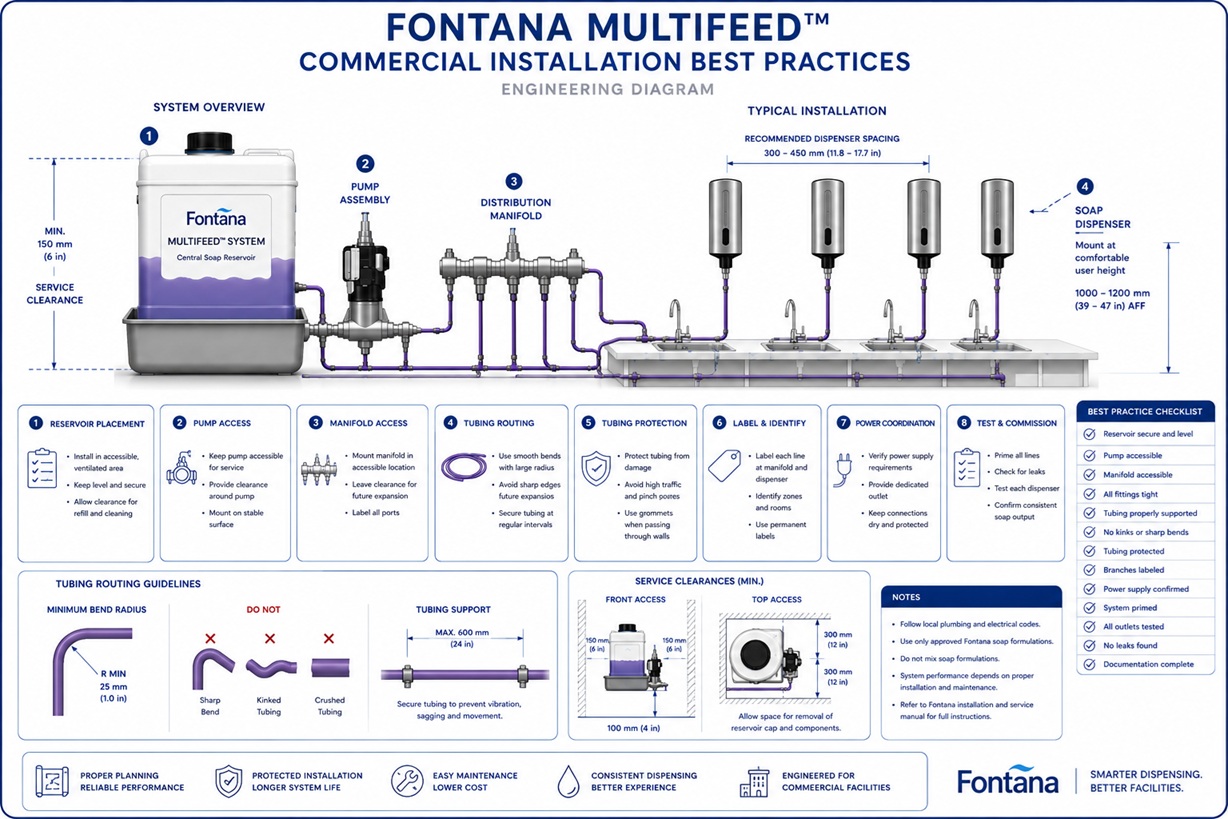
A well-planned installation helps protect system components, maintain consistent
soap delivery, simplify future service, and reduce avoidable commissioning issues.
Reservoir placement, tubing routing, manifold access, dispenser alignment,
power coordination, and branch identification should be reviewed together
before installation begins.
Service Access
Protected Tubing
Clear Labeling
Balanced Routing
Power Coordination
Final Testing
Core Installation Principles
Coordinate the complete supply path from reservoir to dispenser before
permanent mounting, enclosure work, and final connection.
Plan Access
→
Route Tubing
→
Secure Components
→
Label Branches
→
Test System
01
Maintain Service Access
Keep the reservoir, pump, manifold, power connections, and main fittings
accessible for refill, inspection, cleaning, and future replacement.
02
Protect Tubing Routes
Route tubing away from sharp edges, heat sources, moving equipment,
crushing loads, and areas where service activity may cause damage.
03
Avoid Excessive Bends
Use smooth routing and appropriate bend radii to reduce restrictions,
kinks, trapped air, and unnecessary resistance within the soap path.
04
Label Every Branch
Identify manifold ports, restroom zones, branch lines, and dispenser locations
to simplify commissioning, maintenance, and troubleshooting.
05
Coordinate Power Early
Confirm outlet locations, power supply requirements, cable routing,
protection, and accessibility before walls and millwork are closed.
06
Use Approved Soap
Confirm soap compatibility before filling the system and avoid mixing
formulations that may affect viscosity, priming, flow, or component life.
Pre-Handover Installation Checklist
Complete these checks before commissioning and formal project turnover.
Reservoir Secure
Pump Accessible
Tubing Protected
Fittings Tight
Branches Labeled
Power Confirmed
Lines Primed
All Outlets Tested
Installation Notice:
Final installation requirements should follow the selected Fontana MultiFeed™
configuration, approved project drawings, product instructions, applicable codes,
soap specifications, and site-specific conditions.
Need Installation Coordination Support?
Coordinate reservoir location, tubing routes, manifold placement,
power access, service clearances, and commissioning requirements
with the Fontana project support team.
Engineered for Performance.
Designed for Long-Term Reliability.
Fontana MultiFeed™ combines centralized soap distribution,
commercial engineering, scalable architecture,
and simplified maintenance into one integrated dispensing solution
designed for demanding facilities where reliability,
serviceability, and long-term operational performance are essential.
Complete Engineering Support
System Design
& Selection
Technical
Documentation
Installation
Guidance
Commissioning
Support
Maintenance
Programs
Project
Consultation
Let’s Build Smarter
Commercial Washrooms Together
From system design to long-term support, Fontana is your engineering partner
for reliable, efficient, and future-ready commercial soap dispensing solutions.
✓
Proven Performance
♢
Trusted by Facilities Worldwide
◎
Engineered for a Better Experience
Need a custom system design
or project consultation? Contact our engineering team today.
Review frequently asked questions about centralized soap distribution, system planning, installation coordination, maintenance access, commercial applications, and long-term facility operation.
What is a Fontana MultiFeed™ Soap Dispenser System?
+
It is a centralized soap distribution system that uses a shared reservoir and distribution network to supply multiple automatic dispensers.
How does centralized soap distribution work?
+
Soap moves from a central reservoir through coordinated pumps, manifolds, and tubing to the connected touchless dispensing points.
Why use one reservoir for multiple soap dispensers?
+
A shared reservoir consolidates refill points, reduces repetitive servicing, and supports more predictable soap availability across multiple stations.
Which facilities benefit most from a MultiFeed™ system?
+
Airports, hotels, hospitals, universities, stadiums, offices, government buildings, and other high-traffic facilities can benefit from centralized servicing.
How can MultiFeed™ reduce facility maintenance labor?
+
Maintenance teams can refill and inspect centralized components instead of opening and servicing every dispenser individually.
What determines how many dispensers a system can support?
+
The final capacity depends on reservoir size, pump configuration, tubing distances, elevation changes, soap characteristics, and project-specific engineering.
What should be considered when planning the tubing layout?
+
Designers should evaluate tubing length, elevation, routing, bend locations, manifold position, service access, and protection from accidental damage.
Can MultiFeed™ be installed in an existing restroom?
+
Retrofit feasibility depends on counter access, available service space, dispenser compatibility, electrical requirements, and practical tubing routes.
What soap should be used with the system?
+
Use only soap formulations and viscosity ranges confirmed as compatible with the selected reservoir, pump, tubing, and dispenser configuration.
How is consistent dispensing maintained across multiple outlets?
+
Proper pump selection, balanced tubing routes, secure connections, compatible soap, commissioning, and routine inspection support consistent operation.
What routine maintenance does a MultiFeed™ system require?
+
Maintenance may include reservoir inspection, timely refilling, tubing and connection checks, nozzle cleaning, pump evaluation, and dispense testing.
Can the system support future facility expansion?
+
Yes, when future capacity, additional zones, manifold access, tubing routes, and equipment space are considered during initial planning.
Planning a MultiFeed™ Commercial Restroom System?
Review available system configurations and coordinate reservoir capacity, dispenser quantity, tubing layout, installation access, and project requirements.
Fontana MultiFeed™ System Planning and Installation Considerations
Successful centralized soap dispenser installation depends on accurate reservoir sizing, compatible soap selection, accessible service components, proper commissioning, and a documented maintenance plan. Review these essential considerations before specifying or installing a Fontana MultiFeed™ commercial soap dispensing system.
▤
Central Soap Reservoir Capacity
Calculate reservoir capacity according to the number of connected dispensers, projected restroom traffic, soap dosage per activation, daily operating hours, and the facility’s preferred refill interval.
◉
Liquid and Foam Soap Compatibility
Confirm whether the specified MultiFeed™ configuration is designed for liquid or foam soap. Soap viscosity and formulation must be compatible with the selected pump, tubing network, and automatic dispenser outlets.
⚙
Under-Counter Service Access
Maintain clear access to the central reservoir, pump assembly, tubing, filters, control components, power supply, and dispenser connections to support inspection, cleaning, replacement, and troubleshooting.
✓
System Priming, Testing and Calibration
Prime the soap delivery network, inspect tubing and fittings for leaks, test sensor response, confirm pump operation, and verify consistent dispensing volume at every connected fixture before project handover.
↻
Preventive Maintenance and Long-Term System Performance
Establish a maintenance schedule that includes reservoir level checks, soap tank cleaning, tubing inspection, filter service, dispenser output testing, sensor cleaning, and power-component verification. Documented preventive maintenance helps support reliable soap delivery across high-traffic commercial restrooms.
Review installation guidance, maintenance information, soap compatibility questions, and additional technical answers before finalizing your commercial MultiFeed™ system specification.
Centralized Soap Delivery for Complete Commercial Restroom Projects
Fontana Multifeed systems combine centralized soap storage, controlled distribution, accessible maintenance components, coordinated touchless dispensers, and commercial-grade project support. The following planning references summarize how the system can improve specification, installation, servicing, and long-term operation across demanding commercial restroom environments.
A centralized soap distribution system allows one high-capacity reservoir to supply multiple automatic dispensers through a dedicated tubing network. Reducing individual refill points can simplify maintenance scheduling, improve refill efficiency, and help maintain consistent soap availability throughout airports, healthcare facilities, hospitality properties, office buildings, educational campuses, and other high-use commercial environments.
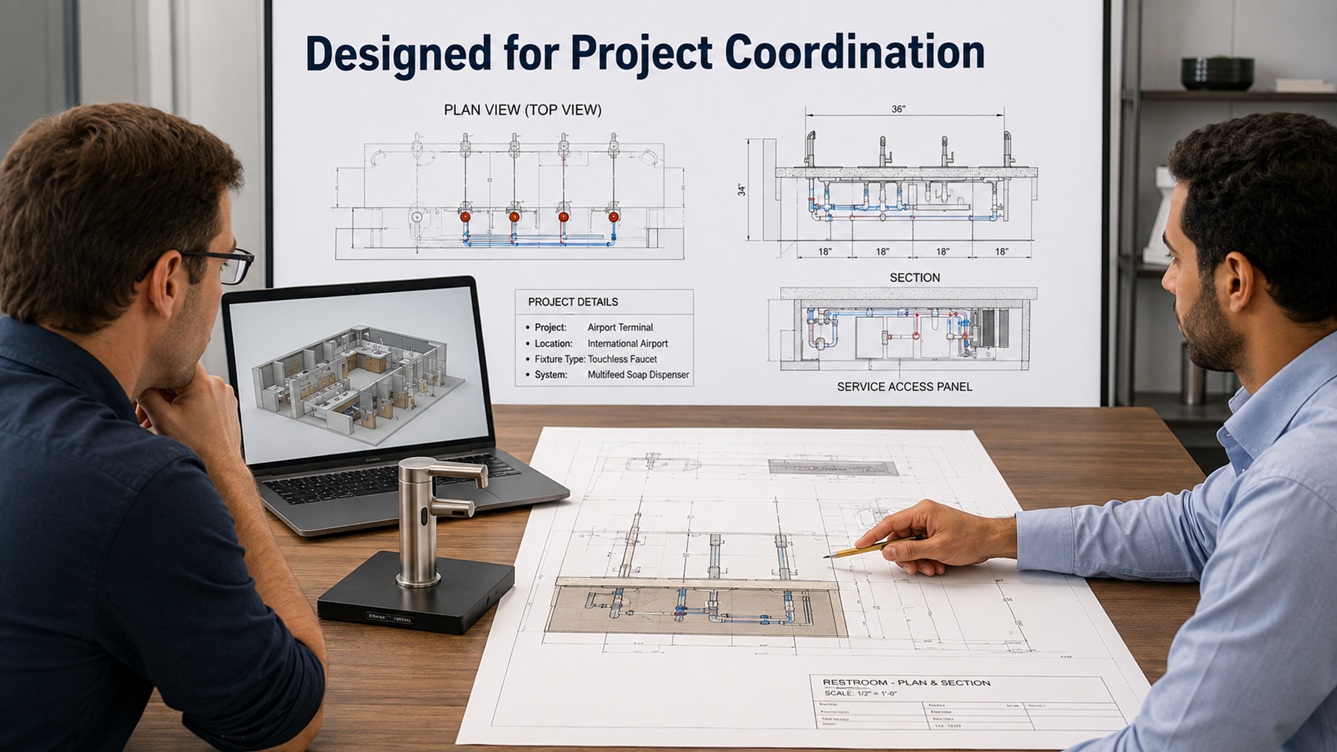
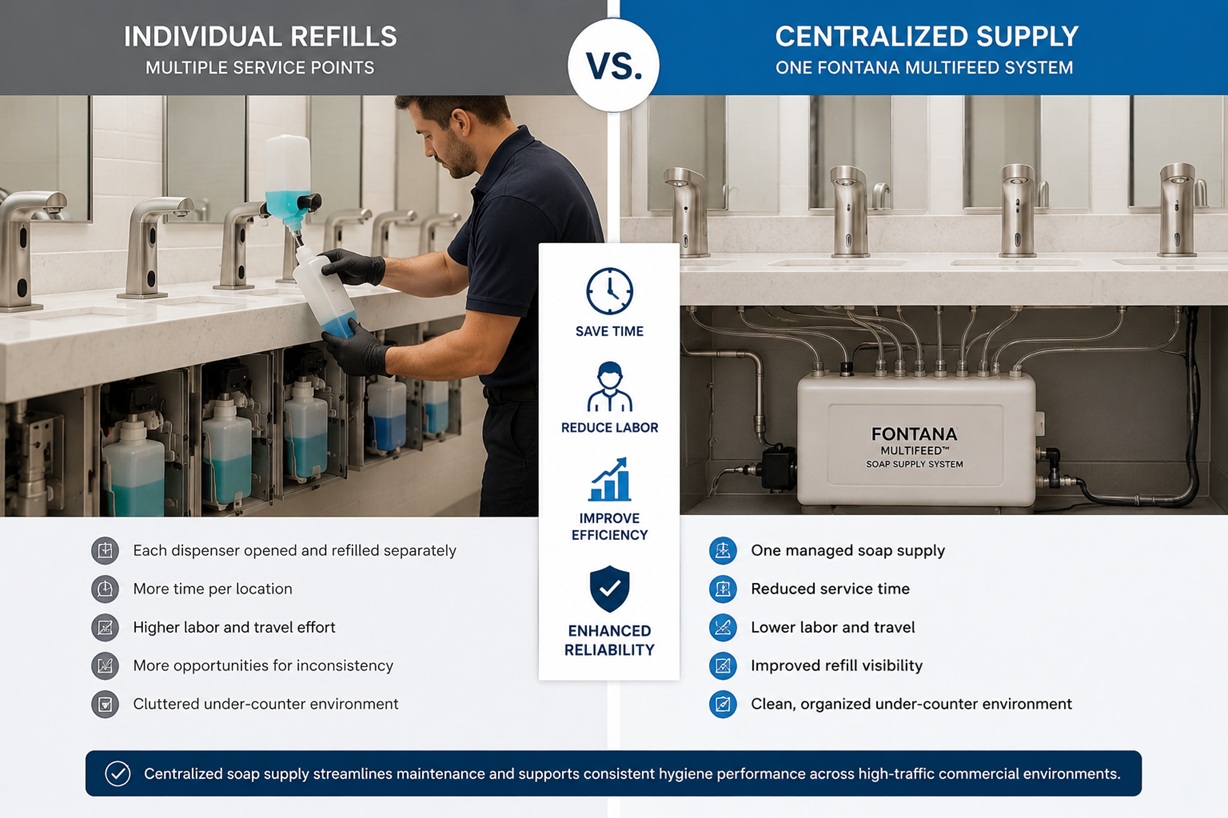
Successful installations begin with early coordination between architects, plumbing engineers, contractors, electrical teams, and facility managers. Planning dispenser spacing, reservoir placement, tubing routes, power connections, fill access, and service clearances before construction helps reduce field conflicts and supports a cleaner, more organized under-counter installation.
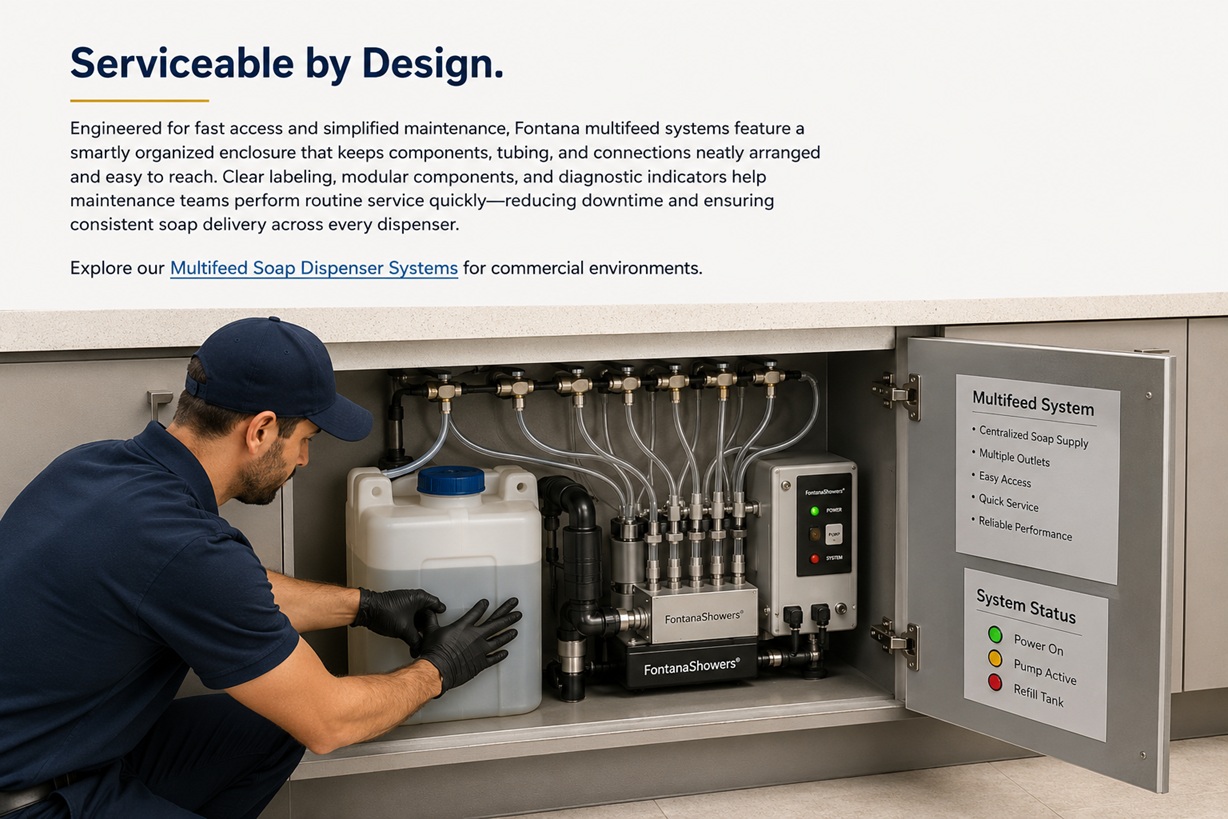
The centralized reservoir, pump assembly, manifold, control components, and service connections can be organized within an accessible cabinet. This arrangement helps technicians inspect, refill, prime, test, and service the system without removing every dispenser or unnecessarily interrupting restroom operation.
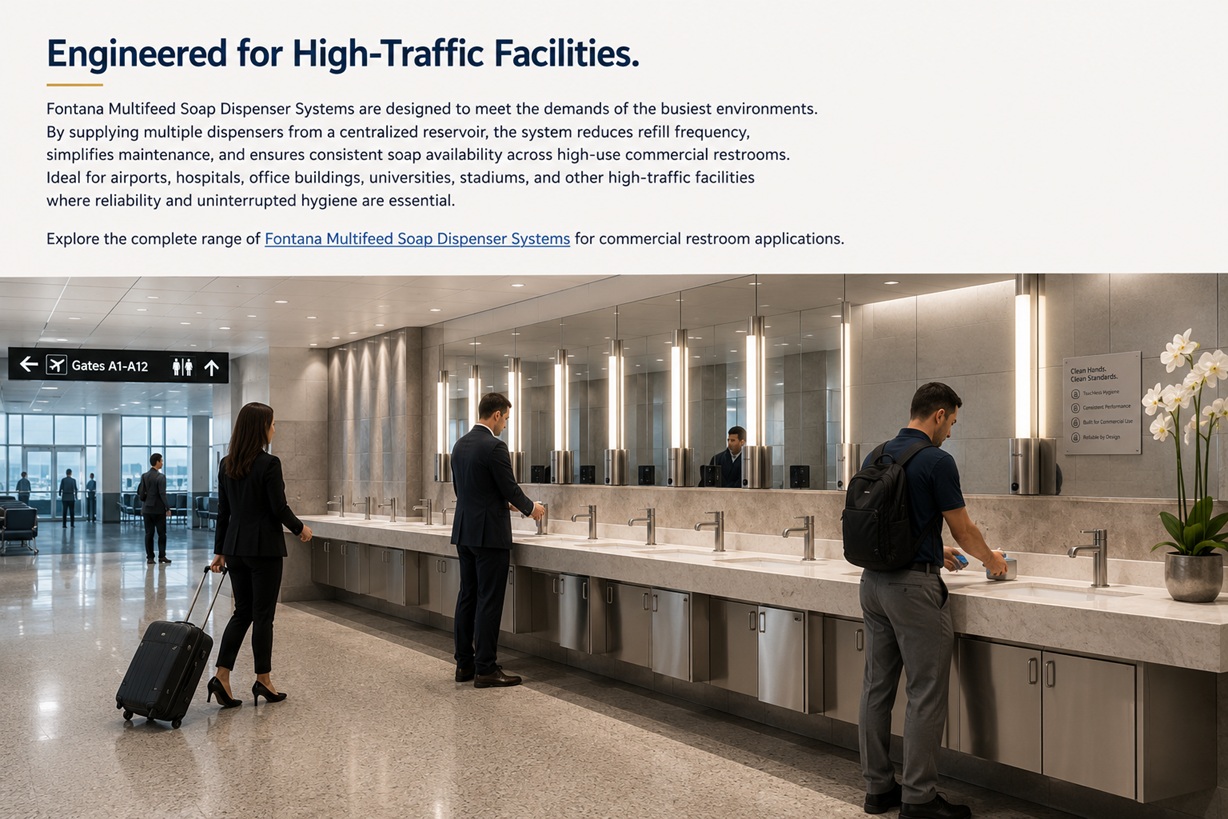
Airports, hospitals, hotels, universities, stadiums, shopping centers, offices, and transit facilities require dependable soap availability under continuous use. Centralized dispensing can reduce refill frequency and help maintenance teams manage multiple outlets from one controlled supply point.
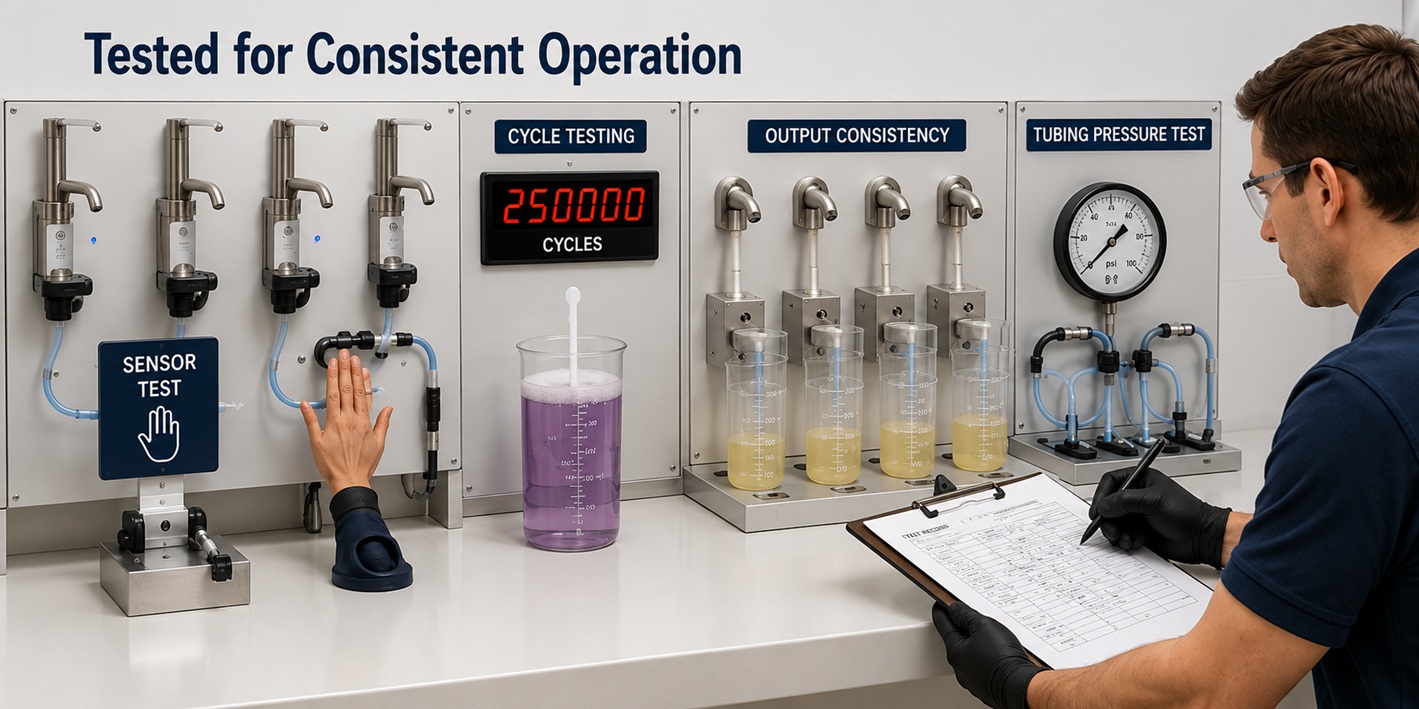
Consistent commercial performance depends on validating sensor response, dispensing output, pump function, tubing pressure, connection integrity, and cycle durability. A structured testing process helps project and maintenance teams confirm dependable operation before turnover and supports more informed troubleshooting throughout the system’s service life.
Traditional installations require each dispenser to be inspected, opened, and refilled separately. A centralized Multifeed configuration consolidates several dispensing points into one managed soap supply, which can reduce repetitive service tasks, shorten maintenance routes, improve refill visibility, and create a cleaner under-counter service environment.
Engineering & Facility Summary
A Complete Centralized Soap Delivery Strategy
From project coordination and organized under-counter routing to accessible maintenance, performance testing, and high-traffic operation, Fontana Multifeed systems are designed to support the full commercial restroom lifecycle. Integrating several dispensers into one managed supply network can help reduce service complexity, minimize downtime, and provide dependable soap availability across every connected handwashing station.
Central Reservoir
Multiple Dispensers
Accessible Servicing
Controlled Distribution
Commercial Reliability
Commercial Specification Support
Plan a Complete Fontana Multifeed Restroom System
Coordinate reservoir capacity, dispenser quantity, soap type, tubing layout, power configuration, finish selection, installation access, and long-term maintenance requirements with Fontana commercial project support.
Specify a Complete Fontana Multifeed Restroom System
Coordinate the centralized reservoir, automatic soap dispensers, touchless faucets, power configuration, tubing, finish selection, service access, and long-term maintenance requirements.
Select a resource below to review MultiFeed system features, installation planning, purchasing guidance, hygiene benefits and frequently asked questions.
Review the primary Fontana MultiFeed system page covering centralized soap delivery, system configuration, commercial applications and principal operational benefits.
Review large bathroom sink dimensions, countertop clearances and fixture-spacing considerations that may influence dispenser positioning and MultiFeed installation planning.
Review important considerations for comparing MultiFeed soap-dispenser brands, including construction, operational reliability, maintenance access and commercial application suitability.
Examine the MultiFeed kit for automatic soap dispensers, including its reservoir, distribution tubing, connection components and coordinated dispensing operation.
Identify dispenser quantities, reservoir placement, installation conditions, soap requirements and project information that should be reviewed before purchasing a MultiFeed kit.
Explore how centralized soap delivery may reduce routine handling, support consistent soap availability and simplify servicing in commercial and public restrooms.
From an architectural workplace-planning perspective, automatic soap dispensers provide a strong combination of hygiene, dependable operation, and long-term suitability for commercial restroom environments. Hands-free dispensing helps reinforce cleaner handwashing practices while reducing unnecessary contact with restroom fixtures, an important consideration in offices and other shared facilities. Consistent performance and durable construction also support lifecycle objectives by helping AEC teams specify restroom systems that can withstand routine daily use. For contemporary workplace projects, automatic soap dispensing offers a practical way to improve hygiene standards while maintaining efficient, reliable, and professionally integrated washroom design.
Commercial Soap Dispensing Engineered for Long-Term Performance
Fontana MultiFeed™ centralized soap dispensing systems support dependable commercial
operation through coordinated soap distribution, touchless activation, controlled dosing,
and centralized maintenance. Reducing individual refill locations can simplify routine
servicing while supporting consistent soap delivery across multiple wash stations.
Designed for airports, healthcare facilities, hospitality properties, educational campuses,
office buildings, and other high-use environments, the MultiFeed™ platform supports scalable
restroom planning, accessible service, coordinated fixture integration, and efficient
long-term facility operation.
Innovation & Sustainability Planning Matrix
Commercial operating benefits across a centralized soap dispensing system
System Feature
Operational Benefit
Maintenance Impact
Sustainability Focus
Central Reservoir
Supplies multiple touchless dispensers from one coordinated soap source.
Consolidates refill activity around one accessible service point.
Supports organized bulk-soap management and fewer individual refill containers.
Touchless Activation
Provides hands-free soap dispensing at each connected wash station.
Supports simplified fixture cleaning and consistent user operation.
Supports hygienic operation by limiting unnecessary physical contact.
Controlled Dosing
Supports repeatable soap delivery across multiple dispensing points.
Helps facility teams maintain consistent dispenser output.
Can help limit unnecessary soap use when correctly configured.
Service Access
Organizes access to the reservoir, pump, manifold, and principal connections.
Supports faster inspection, refilling, maintenance, and troubleshooting.
Accessible servicing can support dependable long-term component operation.
Scalable Architecture
Supports coordinated dispenser groups and project-specific restroom zones.
Clear zoning and branch identification can simplify future service work.
Supports phased planning and potential future system expansion.
Commercial Project Value
One Coordinated System.
Multiple Operational Benefits.
A centralized soap distribution strategy supports simpler refill planning,
organized maintenance access, and coordinated performance across commercial restrooms.
✓Centralized Soap Distribution
✓Touchless Commercial Operation
✓Controlled Soap Dosing
✓Reduced Individual Refill Points
✓Simplified Maintenance Planning
✓Expandable Commercial Architecture
Project Planning Note:
Operational and sustainability outcomes depend on system configuration, dispenser quantity,
soap formulation, dosing settings, facility traffic, maintenance practices, and site conditions.
Get support with MultiFeed™ system selection, specifications, installation planning,
system sizing, finish coordination, and commercial project requirements.
ENGINEERED FOR COMMERCIAL PERFORMANCE
Supporting Reliable Commercial Soap Dispensing from Design Through Daily Operation
Fontana MultiFeed™
centralized commercial soap dispensing systems are engineered to support efficient
soap distribution, touchless hygiene, simplified maintenance, scalable restroom
planning, and dependable long-term operation across airports, healthcare facilities,
hospitality properties, office buildings, educational campuses, and other
high-traffic commercial environments.
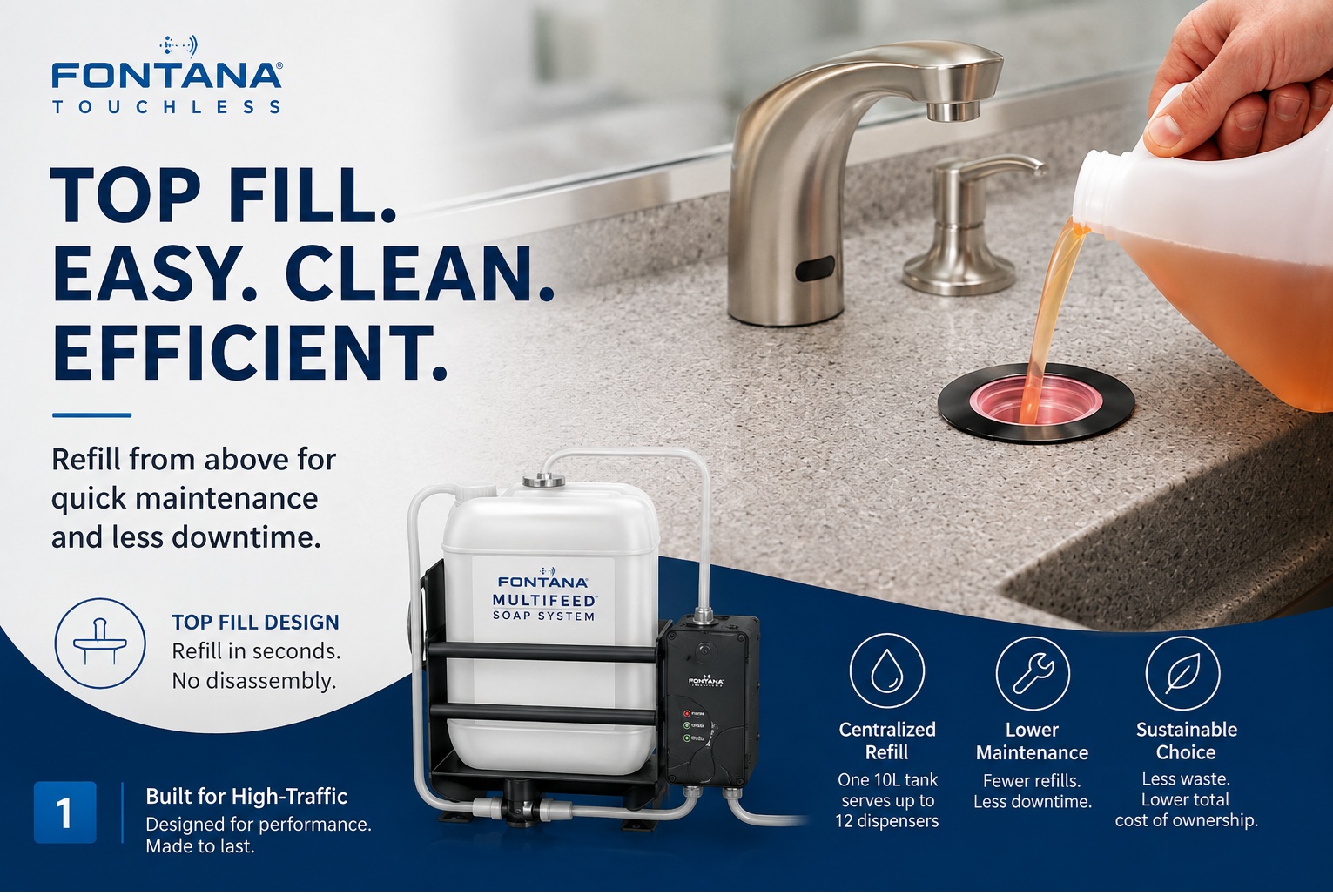
Fontana top-fill soap dispensing systems allow maintenance teams to
replenish soap directly from above the countertop, reducing the need
to access or remove under-counter components during routine servicing.
This approach can shorten refill time and simplify maintenance in
high-traffic commercial restrooms.
For larger facilities, the same maintenance strategy can be combined
with a centralized MultiFeed soap dispenser system,
where a larger soap reservoir supplies multiple dispensing points.
Centralized soap storage can reduce individual refill activity and
make consumable management more predictable across airports, hotels,
universities, office buildings, healthcare facilities, and other
high-use environments.